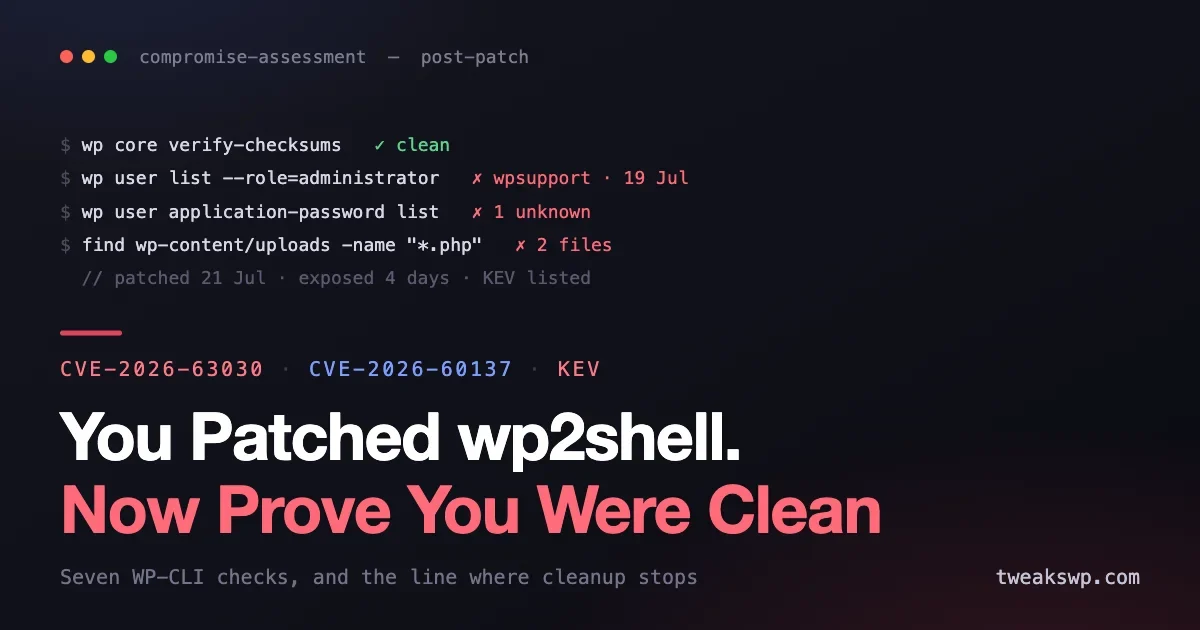
WordPress Malware Cleanup: Developer’s Step-by-Step Recovery Checklist
Step-by-step WordPress malware cleanup checklist covering core file verification, database injection scans, hidden admin detection, cron backdoors, and post-cleanup hardening.
Every WordPress database query that concatenates user input without $wpdb->prepare() is a ticking time bomb. This guide covers every prepare() pattern in production code.
Learn how to set up passkeys and session management for multi-user WordPress sites, reduce password risk, and improve account security with practical controls.
Learn how to implement Content Security Policy in WordPress step by step to reduce XSS risk, lock down script sources, and limit browser-side data exfiltration.
Learn how to defend WordPress against AI-driven bots with automated security responses, rate limiting, bot scoring, challenges, and layered blocking strategies.
Set correct chmod values for wp-config.php, directories, files, uploads, and .htaccess. Includes one-liner fix commands and wp-config.php constants.
Disable XML-RPC, block REST API user enumeration, and stop ?author= redirects with exact PHP hooks, Apache/.htaccess, and Nginx config examples.
Harden WordPress login with PHP rate limiting via transients, a custom login URL using rewrite rules, Application Password controls, and TOTP 2FA. No plugins required.
Three major WordPress plugin vulnerabilities disclosed in early April 2026, Perfmatters (200K sites), Ninja Forms File Upload (50K sites), and MW WP Form (200K sites). What each vulnerability does, whether your site is affected, and the patched version numbers.
A critical unauthenticated SQL injection vulnerability in the Ally accessibility plugin puts 400,000 WordPress sites at risk. How to check if you're affected, how to update, and what to do if you were already compromised.
Even seasoned WordPress developers make predictable security mistakes: nonce misuse, missing capability checks, SQL injection via $wpdb, incorrect file permissions, debug mode in production, no direct file access protection, and gaps in sanitization and escaping. This guide shows each mistake with the wrong pattern and the correct fix.
A practical guide for developers and site owners on hardening WordPress against malware infections and crypto mining scripts - covering server hardening, file monitoring, mu-plugin security, wp-config hardening, malware detection techniques, and signs your site has been compromised.