What Is Partner Enablement?
Partner enablement is training the people outside your company who still represent your brand. Learn how to structure it with Learnomy.

Updated September 2026.
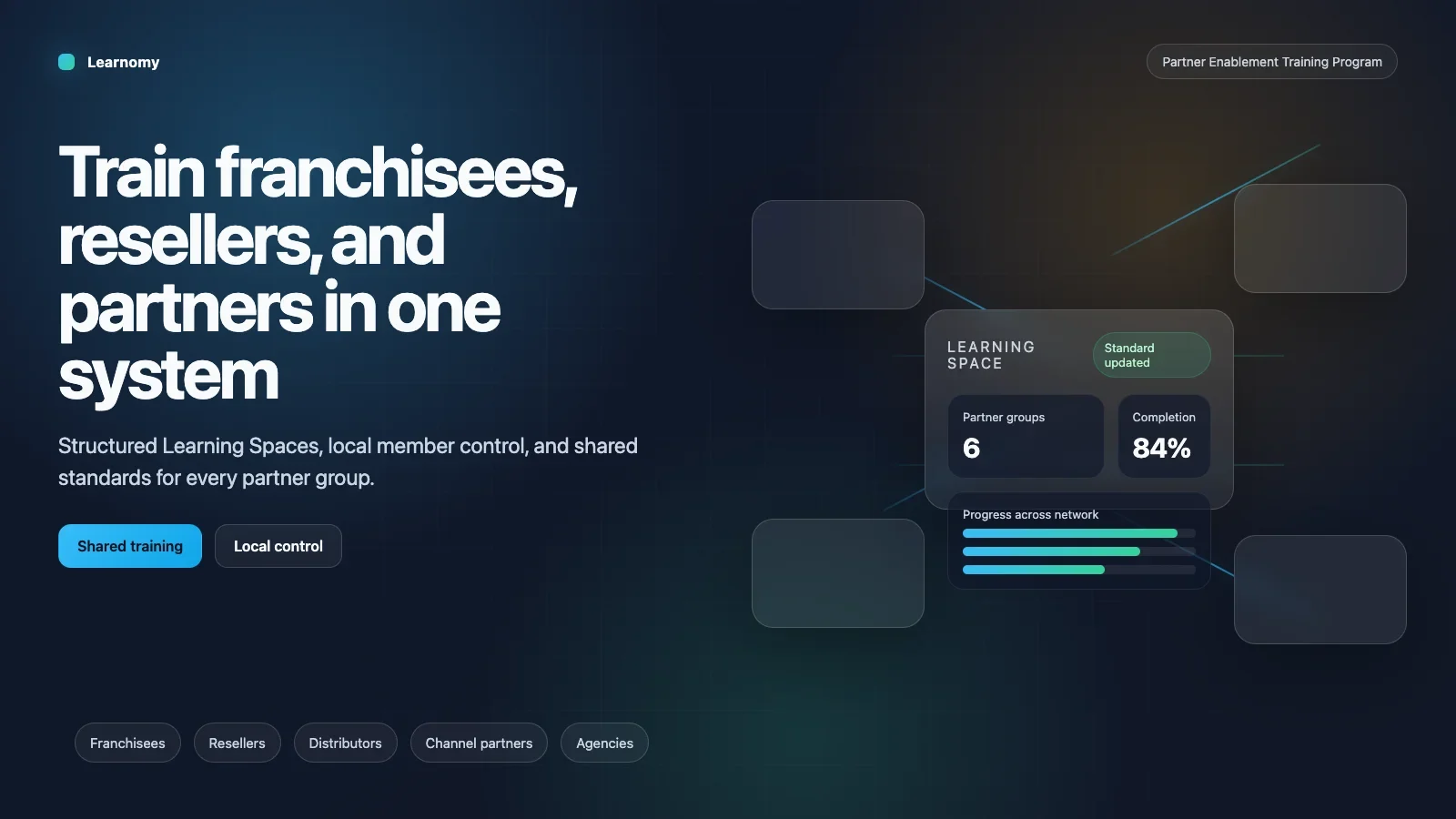
Partner enablement is one of those terms that sounds broad until you are the person responsible for making it work. Then it gets very specific very quickly. You are not just sharing courses with outside people. You are teaching external businesses how to represent your brand without letting the whole system drift into five different versions of itself.
That is the cleanest way I know to describe it.
If you work with franchisees, resellers, distributors, channel partners, agencies, or implementation partners, you are already doing partner enablement whether you call it that or not. The difference is whether you are doing it intentionally, with structure, or accidentally, with email threads and spreadsheets.
That distinction matters because the work is not really about content. It is about consistency. One partner can be good, another can be busy, a third can be new, and if the system does not keep all of them aligned, the customer will feel the difference long before anyone in head office notices it on a report.
Learnomy is useful here because it lets you build a private training environment that is structured enough to stay consistent and flexible enough to let local people manage their own work. That is the balance partner programs need. Central standards, local ownership, and a reporting layer that tells you what is actually happening, delivered without forcing head office to become the bottleneck for every routine change a partner network generates.
In this guide
- What partner enablement actually means
- Why this is not just training
- Who partner enablement covers
- Why consistency is the core job
- How Learnomy maps to that job
- What partner enablement is not
- Partner enablement versus customer education
- Building the vocabulary before the platform
- A day in the life of each role
- When partner enablement is overkill
- How this shows up across industries
- Frequently Asked Questions
- The questions every partner program has to answer
- Common objections and how to answer them
- What to measure once the program is live
- Where the model breaks if you ignore it
- What a good partner enablement system feels like
- How to think about rollout
- Why the term matters for SEO and communication
- Related reading
- Where responsibility sits as the network scales
- What to remember
What partner enablement actually means
At the simplest level, partner enablement means giving an external business the training, access, and support it needs to represent your company properly. But that simple sentence hides a lot of operational decisions.
Do partners see one shared portal or their own space? Who manages the roster? Is the training the same for every partner or customized by partner type? Does head office control everything, or can local managers handle their own people? Those are not minor questions. They define whether the program can scale or whether it will become a manual support burden.
That is why I would not describe partner enablement as a course catalog. A catalog is static. Partner enablement is a system. It has rules, ownership, visibility, timing, and proof.
That is also why the term includes so many different partner models. A franchisee is not the same as a reseller, and a reseller is not the same as an implementation partner. But all of them need a way to learn the standards of the business they are representing. They are different audiences, but they are all part of the same network problem, and treating them as one undifferentiated group is exactly how a program ends up too generic to help any of them.
Why this is not just training
People often hear “training” and picture a few videos or a deck of documents. That is not enough for a real partner network. Training alone does not tell you who owns what. It does not stop one partner from seeing another partner’s data. It does not tell head office who completed which step. It does not protect the brand if the local team improvises.
Partner enablement sits closer to operations than to content publishing. You are not only teaching. You are defining the operating standard that each external business must follow.
That is a much harder problem, but it is also a much more useful one to solve. A content library is easy to build and hard to keep meaningful. A working partner system is harder to build and much easier to trust.
That difference is the whole point of the cluster. The articles are not trying to describe a learning tool in the abstract. They are trying to show how the tool fits the shape of a partner network when the network is real, messy, and growing.
Who partner enablement covers
Partner enablement usually spans more than one audience. That is one reason it gets misunderstood. A single word is covering several different business relationships at once.
Franchisees need brand standards, launch training, operational process, and local roster control. Resellers need product knowledge, sales guidance, objection handling, and updates when the offer changes. Distributors need a different combination of product, support, and logistics. Implementation partners need technical process, customer handoff guidance, and sometimes certification. Agencies may need campaign process, usage rules, and approval steps.
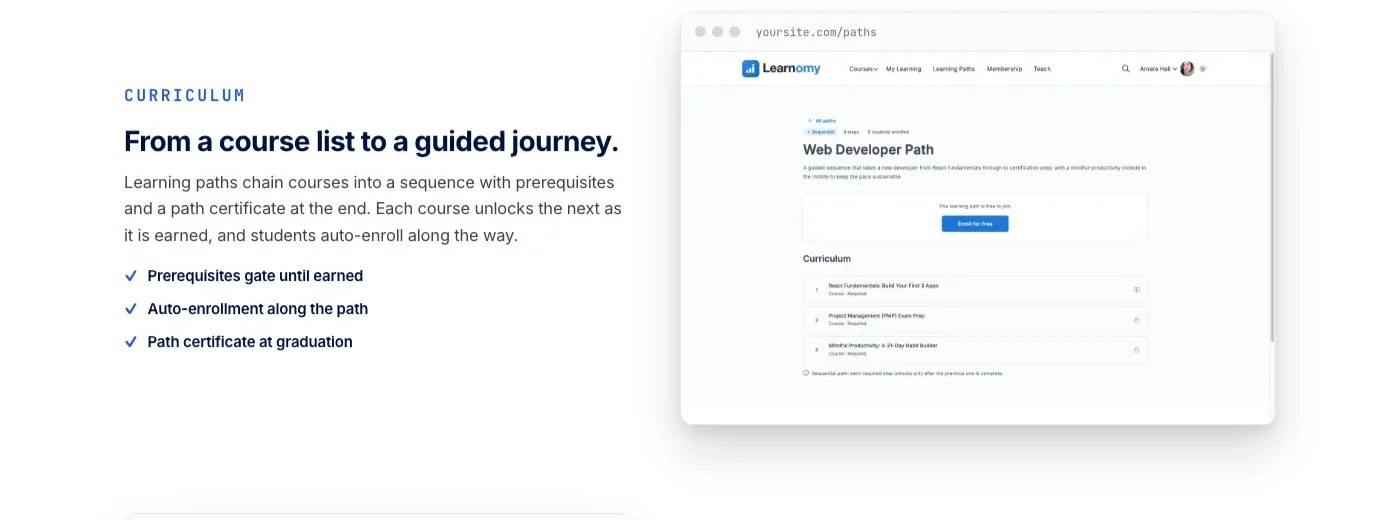
The content changes. The access model changes. The reporting needs change. What stays the same is the requirement for consistency and control.
That is why partner enablement is broader than onboarding and narrower than general education. It is education tied to a business relationship with rules attached to it.
Why consistency is the core job
The reason companies invest in partner enablement is usually not because they love training. It is because inconsistency is expensive.
If each partner trains differently, customers get different experiences. If each location handles access differently, head office loses control. If each manager decides their own version of the process, support becomes harder and the brand gets harder to trust. That is the cost of letting the network drift.
Consistency is the thing the system is really selling. The courses are just the mechanism. The real promise is that the business can grow without the experience changing too much from one location to another or from one partner to another.
That is why standardization is not a boring word in this context. It is the whole job.
How Learnomy maps to that job
Learnomy fits partner enablement because it maps directly to the operational pieces this model needs.
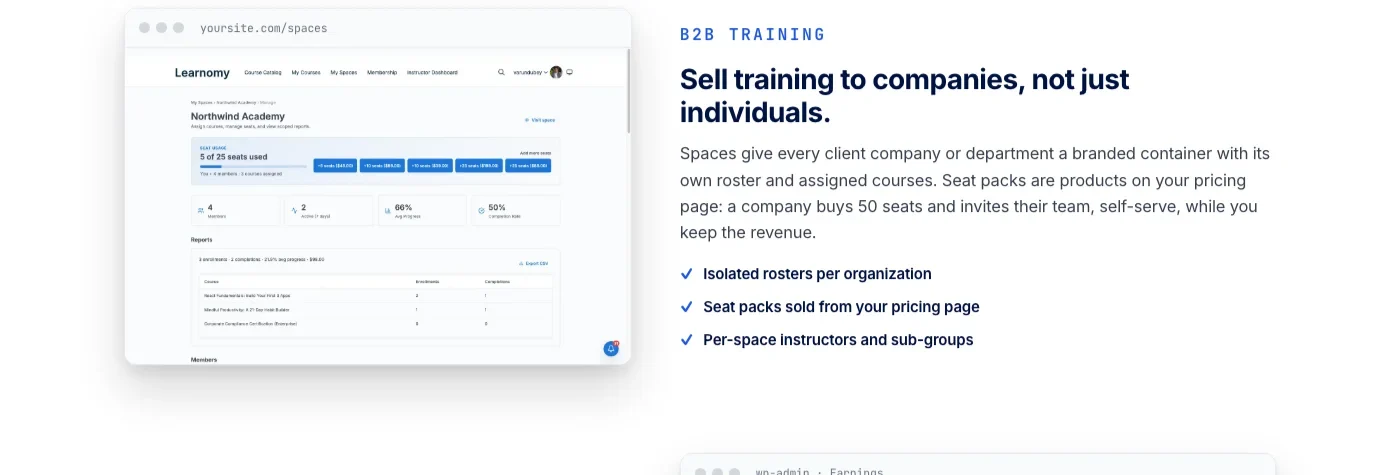
A private portal gives you the right boundary. You are not publishing a public course site. You are creating a private operating space for the network. Spaces let you separate partners or locations so one business does not drift into another business’s training area. Learning paths give you the sequence, which matters when you want the network to learn in the same order. CSV import lets you work from the roster that already exists in the real world. Reports give head office a clean rollup. White-label branding keeps the network identity consistent. And once the content library grows past what one person at head office can write alone, bringing in subject-matter experts to build specific modules instead of authoring everything centrally keeps the standard current without becoming a bottleneck.
Those are not unrelated features. They are the pieces of a single structure.
That is why I would say Learnomy is not just a place to host partner training. It is a system for keeping a partner network aligned. The same completion record that keeps head office confident also gives the partner something concrete: a certificate the partner’s own staff can point to as proof of the training, not just an internal tick mark nobody outside the company ever sees.
What partner enablement is not
It is not just selling courses. That may be one use case, but it is not the full idea. It is not just a login for external people. It is not just a place to upload videos and call it a day. It is not a PDF library with a nicer interface.
Those approaches all miss the structural side of the problem.
When people treat partner enablement as content publishing, they usually end up with one of two problems. Either the system becomes too loose and nobody knows who owns what, or the system becomes too centralized and head office ends up doing work that should have stayed local. Both are symptoms of the same mistake: the structure was never designed properly in the first place.
That is why the topic deserves its own explanation before anyone starts talking about tools. Tools do not fix a bad model. They only make the model easier or harder to maintain.
Partner enablement versus customer education
The two get confused because both involve teaching someone outside the company, but they solve different problems and usually need different structures entirely. Customer education teaches the people who buy your product how to use it well. Partner enablement teaches the businesses that represent your product, or deliver a service under your brand, how to operate the way you need them to operate.
The stakes differ too. A customer who misunderstands a feature has a support ticket. A partner who misunderstands a process has a customer-facing mistake happening under your brand name, at a location you may never visit, handled by someone who was never on your payroll. That gap is why partner enablement carries operational weight that customer education usually does not need: access boundaries, roster ownership, and a reporting layer head office can actually trust.
Some companies need both, run separately. A SaaS company might run public customer education so any user can learn the product, alongside a private partner enablement portal for the resellers who sell and support it on the company’s behalf. Mixing the two into one portal usually ends badly, since a public audience and a controlled partner network need almost opposite privacy defaults.
Building the vocabulary before the platform
Every partner network eventually develops its own internal language, and the earlier that language gets fixed, the less confusion the network carries as it grows. Decide, in writing, what a Space means, what counts as a partner versus a location versus a member, and what the difference is between a report and an export. Small as it sounds, this decision prevents a specific and common failure: two people in the same company using the same word to mean different things in a meeting, each assuming the other agrees with them.
The vocabulary should map directly onto the platform’s actual structure, not onto whatever language a previous, informal process used. If the old spreadsheet called every row a “member” regardless of whether that person was a partner owner, a staff member, or a manager, carrying that habit into the new system blurs distinctions the platform is specifically built to keep separate. Renaming things correctly at the start costs an afternoon. Renaming them after fifty partners have learned the wrong terms costs much more.
A day in the life of each role
Abstract role descriptions are easy to nod along with and easy to get wrong in practice, so it helps to walk through what each role actually does on an ordinary day.
A partner admin logs in, checks whether their team completed this week’s assigned modules, and follows up directly with anyone who has not, without needing to ask head office for a report first. A local manager, if the network separates that role from the partner admin, watches a narrower slice, usually a single site or team, and handles the same follow-up at a smaller scale. A regional lead checks a rollup across several partners, looking specifically for outliers, a location moving much slower than its peers, rather than reviewing every individual completion. Head office checks the network-wide summary on whatever cadence the business has settled on, weekly or monthly, and steps in only when the summary shows a pattern worth investigating, not for routine day-to-day management.
Notice what does not happen in this picture: head office is not manually tracking individual completions, and a partner admin is not waiting on head office to tell them who on their own team needs a nudge. That division of labor, each role acting on the slice of data relevant to them, is the actual outcome a well-structured partner enablement system produces. Everything else in this cluster exists to make that division possible.
When partner enablement is overkill
It is worth being honest about when this level of structure is not worth building yet. A company with two or three partners, all known personally to the founder, can often run on a shared folder and a monthly call without losing much. The cost of informal management only becomes visible once the network grows past the point where one person can hold the whole picture in their head, typically somewhere in the range of five to ten active partners, though the exact number depends on how much each partner relationship actually requires.
Building a full private portal, role hierarchy, and reporting layer for two partners is not caution, it is premature structure, and it usually gets abandoned half-finished because there was never enough real usage to justify maintaining it. The better move for a very small, early network is to note which decisions will matter later, who owns the roster, what content is mandatory, how reporting should work, without building the full system until the network is large enough to actually need it.
How this shows up across industries
The shape of partner enablement stays consistent even though the details change by industry. A food franchise needs brand standards, food safety certification, and a launch sequence before a new location can open its doors, with local ownership over daily staff scheduling and shift training. A SaaS reseller channel needs product knowledge, competitive positioning, and deal registration process, with far less need for physical-location training and far more need for keeping pace with a product that changes every quarter.
A home services franchise, cleaning, landscaping, repair, sits somewhere between the two: brand and safety standards matter as much as they do for food, but the training often needs to reach a rotating pool of field technicians rather than a fixed set of location staff. A network of independent financial advisors operating under one brand needs compliance training that can genuinely stand up to regulatory review, which raises the importance of the audit trail well above what a typical reseller network needs.
What stays constant across all four examples is the underlying question: who is allowed to see what, who owns the roster, and how does head office know the standard is actually being met. The content differs. The structural questions do not.
Key takeaways
- Partner enablement is a system with rules, ownership, and visibility, not a course catalog.
- Franchisees, resellers, distributors, and implementation partners all need consistency, but the content and access model differ by type.
- The most common failure is a permissions model that was not scoped tightly enough from the start, not a lack of content.
- Below five to ten active partners, an informal process is usually fine. Past that, structure stops being optional.
- Track variance across the network, not just completion rate. That is the number that shows whether the program is actually working.
Frequently Asked Questions
Is partner enablement the same as channel partner training?
Channel partner training is one specific form of partner enablement, focused on resellers and distributors. Partner enablement is the broader category that also covers franchisees, implementation partners, and agencies.
Does partner enablement require a dedicated platform, or can a company use a shared drive?
A shared drive can work for a very small, informal network, but it breaks down once there is more than a handful of partners, because it has no way to enforce access boundaries, track completion, or separate one partner’s data from another’s.
Who typically owns the partner enablement program inside a company?
It varies. Franchise businesses often run it out of operations. SaaS companies usually run it out of the partnerships or channel team. Regardless of department, the program needs one clear owner responsible for the standards, even if local rosters are managed elsewhere.
How is partner enablement different from a generic corporate LMS rollout?
A corporate LMS trains employees who already share one set of company systems and one HR record. Partner enablement trains people at businesses you do not employ, which means the access boundaries, roster ownership, and privacy defaults all need to be stricter from the start.
What is the first sign a partner network has outgrown an informal process?
Usually it is a customer-facing inconsistency, two locations giving a customer different answers to the same question, that traces back to one partner never getting the same training as the others. That gap is the signal to move from informal management to a structured system.
The questions every partner program has to answer
Before a partner training system works, someone has to answer a few practical questions.
Who sees the training? Who owns the roster? Who can add or remove people? Does each partner get its own space or does one network view cover everyone? Does head office need visibility into all partners, or only the summary? Is the training the same for every partner or adjusted by role, region, or product line?
Those questions sound administrative, but they define the experience. If the answers are unclear, the portal becomes confusing very quickly. If the answers are clear, the portal feels obvious, and that is a much better sign than a flashy interface.
Obvious is good. Obvious means the system reflects the way the business really works.
Common objections and how to answer them
A few objections come up almost every time a company considers formalizing partner enablement, and each one is worth answering directly rather than dismissing.
“Our partners already know what they’re doing.” Often true for the first few, the ones who joined early and learned by working closely with the founder. It is rarely true for partner number twenty, who never had that direct access and is filling gaps with guesswork. Structure protects consistency for the partners who did not get the founder’s personal attention, not just the ones who did.
“This will slow partners down.” A poorly built portal slows people down. A well-built one removes the back-and-forth of emailing head office for basic answers, which is usually slower than the training itself. The complaint is often really about a bad implementation, not the concept of structured partner training.
“We don’t have time to build this properly.” This is the argument for starting with one partner and one Space rather than the argument against starting at all. A single working slice takes far less time than teams expect, and it is the only way to find out what “properly” actually requires for this specific network.
What to measure once the program is live
Once a partner enablement program is running, the temptation is to measure completion rate and stop there. Completion rate answers whether people clicked through the material. It does not answer whether the network is actually more consistent than it was before, which is the entire point of the exercise.
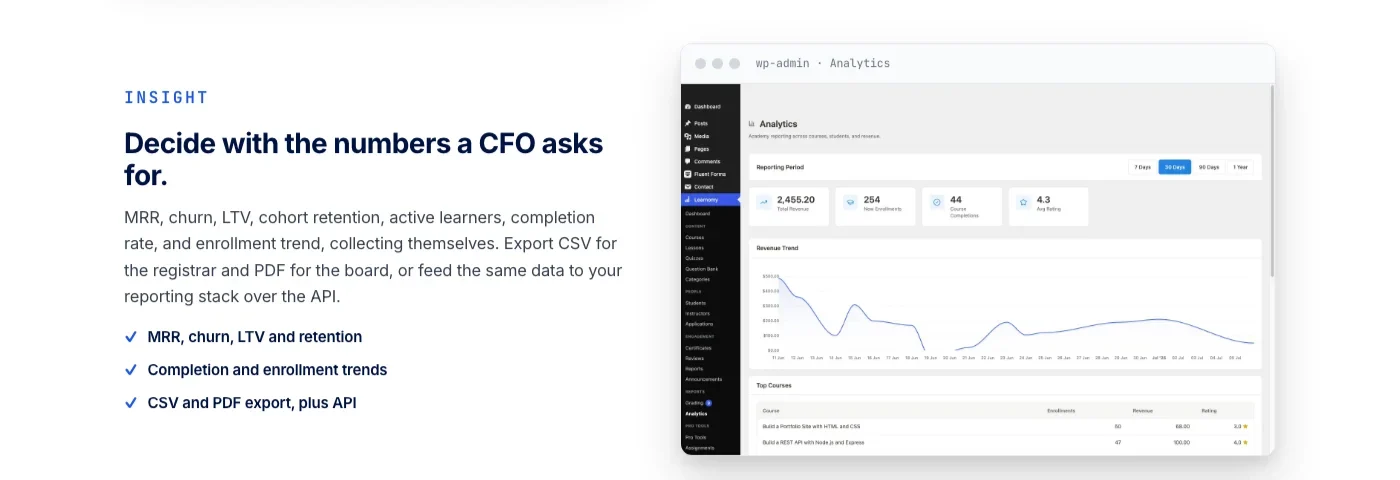
A more honest measure is variance: how differently are partners actually behaving day to day, compared to before the program started. That is harder to quantify directly, but it shows up in proxies worth tracking, customer complaint patterns by location, mystery-shop or spot-check results if the business runs them, and how often head office gets pulled into resolving a dispute that should have been prevented by training. A falling trend in any of these, alongside a rising completion rate, is the real signal that the structure is doing its job rather than just producing a good-looking dashboard.
Time saved at head office is the other number worth tracking, even informally. If the operations team used to spend several hours a week fielding basic partner questions and that time has genuinely dropped since the portal launched, that is the clearest possible evidence the system replaced manual coordination with structure, which was the original problem this whole approach set out to solve.
Where the model breaks if you ignore it
The most common failure is shared access with no boundaries. One partner sees another partner’s people. One manager updates the wrong roster. Head office gets dragged into every small task. Nobody trusts the reports because the structure itself is muddy.
Another common failure is overcustomization. Every partner gets a different training path, a different layout, a different naming system, and eventually nobody can tell which pieces are standard and which pieces are local preference.
The third failure is the opposite. The system is so centralized that no local person can do anything useful without asking head office. That feels controlled at first. Later it turns into a bottleneck.
Partner enablement has to avoid all three. The trick is to stay standardized at the level of the brand and flexible at the level of the location or partner.
What a good partner enablement system feels like
When the setup is working, it feels boring. That is the good version of boring.
The right partner logs in and sees the right training. The local manager can update the roster. Head office can see the network rollup. No one is manually copying spreadsheets between systems just to answer a question. The process runs the same way every time.
That feeling is important because it tells you the structure is doing its job. The software has disappeared enough that the workflow is visible instead.
That is usually the real test of a good operational system. Not whether it looks impressive on day one, but whether it still makes sense after the tenth location, the fiftieth partner, and the hundredth user update, handled by someone who was not in the room when the system was originally designed.
How to think about rollout
If you are implementing partner enablement in a real company, do not start by trying to build the entire network at once. Start with one partner type or one location. Set the private portal. Create one Space. Define one learning path. Make the roster import work. Confirm the report view. Make sure the local manager can do the local work.
Then repeat it.
That approach is slower than trying to sketch the whole future on a whiteboard, but it is much safer. A working first version teaches you where the real friction is. It also tells you which parts of the structure are essential and which parts are just decoration.
In partner networks, simple is often more durable than clever, and a plain structure that everyone understands beats an elegant one that only the person who built it can explain.
Why the term matters for SEO and communication
From a search perspective, “partner enablement” is a useful umbrella term because it captures multiple real buyer intents. Someone searching for franchise training, reseller training, distributor onboarding, or partner portal setup may all be trying to solve the same underlying problem even if they phrase it differently.
That is why this concept post matters. It lets the rest of the cluster hang together. It gives readers a clean definition, and it gives search engines a clear topic center for the rest of the articles.
That also means the wording should stay plain. If you overcomplicate the concept, you lose the people who actually need it. The best explanation is usually the one that takes a messy business problem and makes it feel obvious.
Related reading
If you want the practical setup next, read How to Build a Partner Training Portal with Learnomy.
If you want the franchise version, read How to Train Franchisees Online with Learnomy.
If the structure is your bigger question, continue with How to Organize Multiple Franchise Locations in One Training System, How to Give Each Partner Their Own Training Space, and How to Track Partner Training Progress Across a Network.
For the full picture of how these pieces fit together, start with the hub post: Partner Enablement Training with Learnomy: How to Build a Network That Stays Consistent. And if your audience is internal staff rather than external partners, the same structure applies in How to Build an Employee Onboarding Training Platform with Learnomy.
Give your partner network the structure it needs
A private portal, Spaces per partner, learning paths, roster import, and reporting your team can actually trust.
Where responsibility sits as the network scales
Ownership tends to shift in a predictable pattern as a partner network grows, and naming that pattern in advance saves a company from renegotiating the same argument every time headcount changes. In the earliest stage, one person, often a founder or an operations lead, owns everything: the content, the roster, the reporting. That works fine up to a handful of partners.
As the network grows past that point, the roster work is usually the first thing to move to local owners, since it is the most repetitive and the least strategic. Reporting stays centralized longer, because head office still wants one place to see the whole picture even after individual admin tasks have been pushed outward. The last piece to decentralize, if it ever does, is the standards themselves, brand guidelines, required modules, compliance content, which usually stays owned centrally even in a mature, fully distributed network, precisely because letting that drift is the exact problem partner enablement exists to prevent.
Recognizing this pattern early means a company can design the roles correctly from the first Space rather than discovering the right ownership split by trial and error after a few uncomfortable escalations.
What to remember
Partner enablement is the operating model that keeps external businesses aligned. If you remember only one thing, remember that the structure matters as much as the content. The cleaner the structure, the easier it is to keep the network consistent as it grows.
That is why the portal, the spaces, the learning path, and the reporting layer all have to work together. A single missing piece weakens the whole thing.
That is the core lesson behind the whole cluster, and it is worth restating plainly before moving into the setup guides: the tool never fixes a model that was never designed, it only makes a well-designed model easier to run and a poorly designed one easier to run into the ground faster.
Plugins we build and run
We maintain these ourselves, which is why we can support them on your site.
- BuddyNextThe self-hosted community engine for WordPress
- BuddyXFree community theme, Pro when you outgrow it
- ReignPremium community theme. Add pieces, build anything
- JetonomyCommunity forum and Q&A for WordPress
- EventonomyEvents and RSVPs for WordPress communities
- LearnomyCourses and learning communities on WordPress
- ListoraDirectories and listings your members can browse
- SnipShareCode sharing built for developer communities
- WB Ad ManagerAd placements that turn traffic into revenue
- WP Career BoardA job board your community actually uses
- WP Sell ServicesSell services with offers, orders, and payouts
- MediaVersePhotos, video, and media albums for members
- WB GamificationPoints, badges, and rewards that keep members active
- Product RoadmapPublic roadmaps with voting your users trust