How to Train Franchisees Online with Learnomy
A franchise training setup needs consistency, local roster control, and reporting. Learnomy gives you the structure for all three.

Franchise training is about one thing above everything else: consistency. Every location has to deliver the same experience, even when the staff changes. That sounds simple until you try to manage it across multiple branches, multiple owners, and a growing list of new hires. Then the manual process starts to break, usually in the exact place where the team was most confident it would hold.
That is why a franchise network needs an online training system, not just a course library.
Learnomy fits that model because it lets you keep the brand standards central while still giving each location its own roster and training space. That combination matters. The franchise needs one standard, but the people who run each location still need local control.
This article is about that balance. It is the version you want when the business is serious about growth and does not want the training process to become a support burden.
Why franchise training needs structure
A franchise is not a loose group of independent sites. It is a network that sells the same promise in multiple places. If training drifts, the promise drifts with it.
So the training system has to do two things at once. It has to be centrally consistent, and it has to be locally manageable. Head office needs the standards. The local owner needs the roster. The manager needs a simple way to add and remove people without calling headquarters every time.
That balance is the whole game. Without it, one branch improvises, another branch copies the wrong version, and the customer ends up feeling the difference even if nobody inside the company can quite explain where the drift started.
Franchise training is really a brand protection exercise. The learning system exists so the brand keeps meaning the same thing in every location.
Give every location its own Space
Each franchise location should manage its own roster inside its own Space. That keeps Riverside separate from Northgate and keeps one branch from seeing another branch’s staff. It also gives each location a clear operational boundary.
That separation is what makes the system manageable. Local owners can update their own people. Managers can handle joiners and leavers. Head office stays focused on the standards and the overall picture.
Once the Space exists, the work becomes much more predictable. People know where to go. Managers know what they own. The network starts to behave like a network instead of a shared workroom.
This is the part that usually determines whether the franchise setup will scale cleanly or not. If the first location is messy, every new location adds more mess. If the first location is structured, each new location is easier to replicate.
Keep the brand standards shared
Franchise training is not supposed to become local artwork. The brand belongs to the network.
Learnomy’s white-label setting lets you keep the look and feel consistent across the whole platform. That is the right model for a franchise because the portal should reinforce the same standards that the customer experiences in the field. If the training portal looks and behaves differently in every branch, you are already teaching people that local variation is normal.
That is not the message a franchise should send.
The brand should feel stable. The portal should feel stable. The training should feel like one system, not a stack of local preferences wrapped in one product name.
Use learning paths for the standard sequence
One franchise may have multiple roles, but the training order still needs to be controlled. Learning paths let you define the sequence once and repeat it everywhere.
That helps with onboarding, product updates, compliance, launch training, and anything else that has to happen in a specific order. It also makes it much easier to update the network when the process changes. You update the path, and the structure stays intact.
Without that structure, each location starts improvising. That is where inconsistency begins. A manager skips a step because the staff is busy. Another location reorders the modules because it feels more convenient. Soon the “standard” is no longer standard at all.
Learning paths stop that drift by making the order visible and repeatable.
Let local managers own the roster
Head office should not be the bottleneck for every new hire.
The local manager knows who started, who left, and who needs access changed today. The portal should support that reality instead of forcing everything through central admin.
That is one of the reasons this model scales. A franchise network can add branches, hire seasonally, and change managers without breaking the training workflow if each location is allowed to own its own roster.
That local ownership is also healthier for adoption. People use tools they can control. They resist tools that make them wait.
Use reporting to protect the network
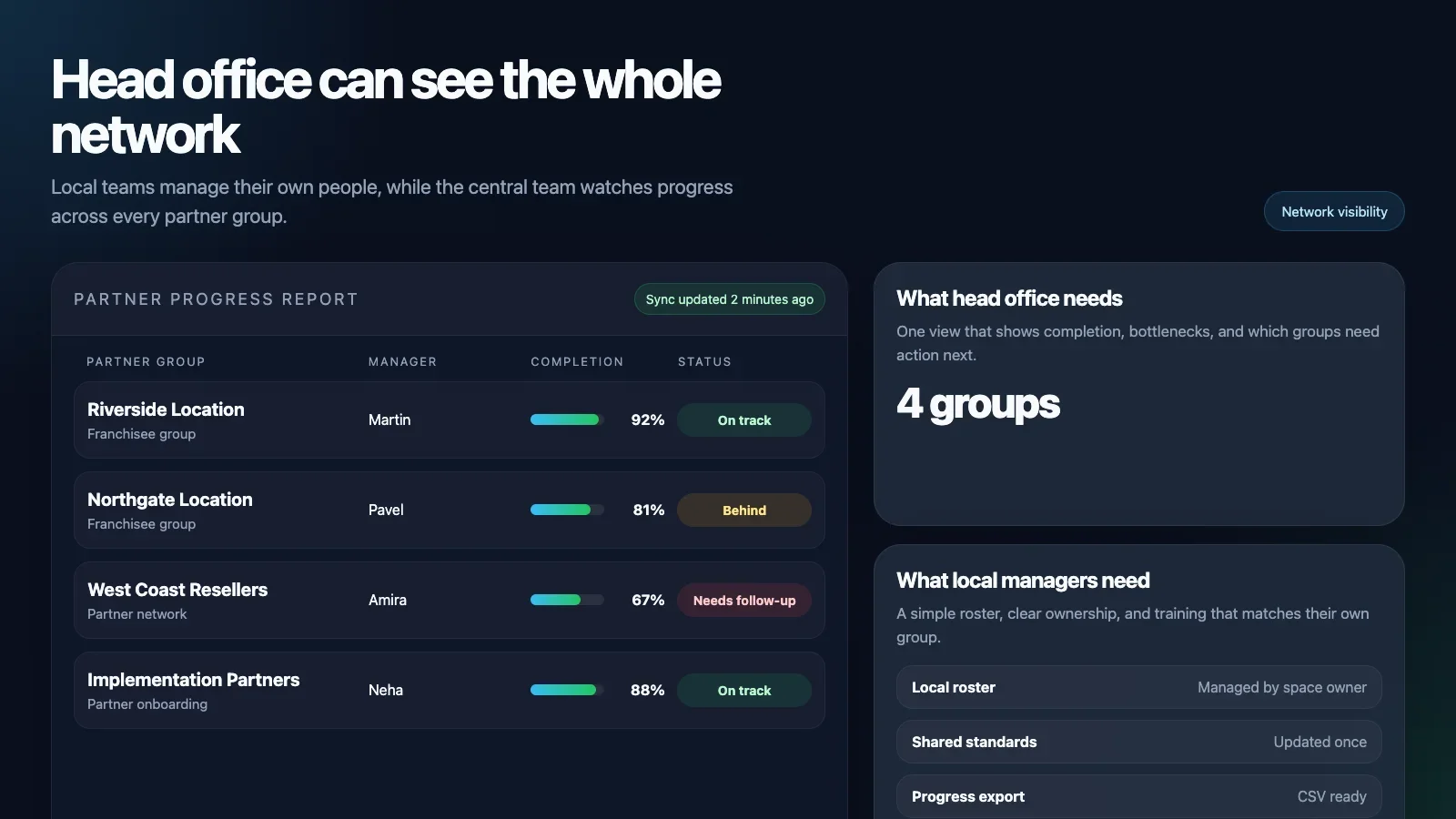
Head office needs visibility into completion across the network, not a stack of manual updates from every branch.
Learnomy reports give you that rollup. You can see which locations are on track and which ones need help before the gap becomes a customer problem. That means training stops being a side activity and becomes part of the operational rhythm of the business.
That is the point where the training system starts paying for itself. Instead of wondering who completed what, you can see it. Instead of asking managers for updates, you can review the state directly.
The report does not replace conversation, but it makes the conversation better. You are discussing actual status rather than trying to reconstruct it from memory.
What should be mandatory
Franchise training should usually cover a few categories every time. Brand standards. Customer handling. Product knowledge. Local process. Compliance where relevant. Launch procedure. Escalation paths. That does not mean every location needs the same depth for every topic, but it does mean the system should be able to enforce the required order.
That is where a learning path is more than convenience. It becomes the backbone of the franchise model.
Some of the content will be policy. Some of it will be operational. Some of it will be what I would call “no surprises” training, the kind that prevents a customer from noticing that one branch is doing things differently from another.
Training is useful when it helps the business avoid those surprises.
What I would launch first
If I were setting up the first version of a franchise training system, I would keep it simple and explicit.
- one private portal
- one Space per location
- one standard learning path
- local roster control
- network progress reporting
- shared white-label branding
That is enough to start. The mistake is trying to build the whole franchise structure in one shot. Most of the useful learning happens after the first location is live, because that is when the team finds out what really matters.
Once the first site works smoothly, the next site becomes a replication exercise rather than a redesign.
What can go wrong
The most common failure is pretending that every location can be managed from a single central roster. That feels neat until the network grows. Then central admin becomes the bottleneck and the system starts to slow down in exactly the place where speed matters.
The second failure is local improvisation. A location decides to run its own version of the standard because it feels faster. That creates inconsistency, and inconsistency in a franchise is basically product drift by another name.
The third failure is overcomplication. The team designs too many exceptions, too many views, too many special cases. The portal becomes technically capable and operationally hard to use. That is the point where people start saying the system is powerful, which is usually a sign that they no longer find it simple.
Simple systems scale better because people can actually remember how to use them.
Why the first week matters
The first week of a new franchise hire tells you everything about the system. If they can log in, see the right path, and understand what is due, the training has a chance to work. If they have to ask three people to figure out where to start, the portal is already failing.
The right first-week experience is calm. It should not feel overloaded. It should not feel random. It should not feel like someone threw a stack of PDFs at the learner and hoped for the best.
That is another reason a portal matters. It gives the first week a shape.
Where this article fits in the cluster
This article is the franchise-specific layer. It sits between the general partner concept and the multi-location network model. Someone reading it should understand that franchise training is not about creativity. It is about protecting the same promise across different branches with different staff and different local conditions.
If they need the broader frame, they should read the concept post. If they need the location-level structure, they should move to the multi-location post. If they need the actual portal setup, the portal article is the next stop.
Related reading
Read What Is Partner Enablement? for the broader concept. Read How to Build a Partner Training Portal with Learnomy for the portal setup. Read How to Organize Multiple Franchise Locations in One Training System for the network model.
If the next thing you need is local ownership, continue with How to Give Each Partner Their Own Training Space.
Try Learnomy here: learnomy.app | live demo | YouTube video
References worth keeping nearby: WordPress Users and WordPress Roles and Capabilities.
What the first rollout should prove
The first rollout is not supposed to prove that the portal is finished. It is supposed to prove that the structure works. Can a location owner manage the roster without calling head office? Can a learner find the right path without asking for help? Can the central team see the rollout without manually collecting updates? If the answer is yes, the model is working.
That is a much better success criterion than “all the content is uploaded.” The content is only useful when the operating model behind it is stable.
How to keep the standard alive after launch
Training programs usually drift after launch because nobody owns the updates clearly enough. A new process arrives, a policy changes, or a product step gets refined. If the training system is treated like a static library, the franchise starts teaching old behavior. That is where small inconsistencies become expensive.
The fix is to treat the portal like a living system. The central team updates the standard. The local manager keeps the roster current. The report shows whether the update actually landed. That is the loop that keeps the standard alive.
What head office should avoid
Head office should avoid becoming the only place that can fix local issues. It should not be the bottleneck for new joiners, roster changes, or routine access updates. If every small change has to go through HQ, the network slows down and the local team stops taking ownership.
The role of head office is to set the standard and check that the standard is being followed. It is not to become the admin desk for every branch.
Why the first week is still the real test
The first week tells you whether the structure is understandable. If the learner can see what they need now and what comes next, the system is doing its job. If they get a wall of content and a confusing start, the system is already leaking.
That is why the portal is more than a nice wrapper. It gives the first week a shape, and that shape is what makes the franchise feel controlled instead of improvised.
Long-form references
Use the product page here: learnomy.app. Use the live demo here: wbcomdesigns.com/downloads/learnomy. Use the video here: YouTube video.
What to remember
Franchise training works when the standard stays the same in every branch. The portal should make that repeatable, not fragile, so each location can learn the same way without inventing its own version of the process.
Plugins we build and run
We maintain these ourselves, which is why we can support them on your site.
- BuddyNextThe self-hosted community engine for WordPress
- BuddyXFree community theme, Pro when you outgrow it
- ReignPremium community theme. Add pieces, build anything
- JetonomyCommunity forum and Q&A for WordPress
- EventonomyEvents and RSVPs for WordPress communities
- LearnomyCourses and learning communities on WordPress
- ListoraDirectories and listings your members can browse
- SnipShareCode sharing built for developer communities
- WB Ad ManagerAd placements that turn traffic into revenue
- WP Career BoardA job board your community actually uses
- WP Sell ServicesSell services with offers, orders, and payouts
- MediaVersePhotos, video, and media albums for members
- WB GamificationPoints, badges, and rewards that keep members active
- Product RoadmapPublic roadmaps with voting your users trust