Can you create an android app from a WordPress site?
Yes, you can turn a WordPress site into an Android app: PWA, Trusted Web Activity, app builder or native REST API app, plus the Google Play rules for 2026.
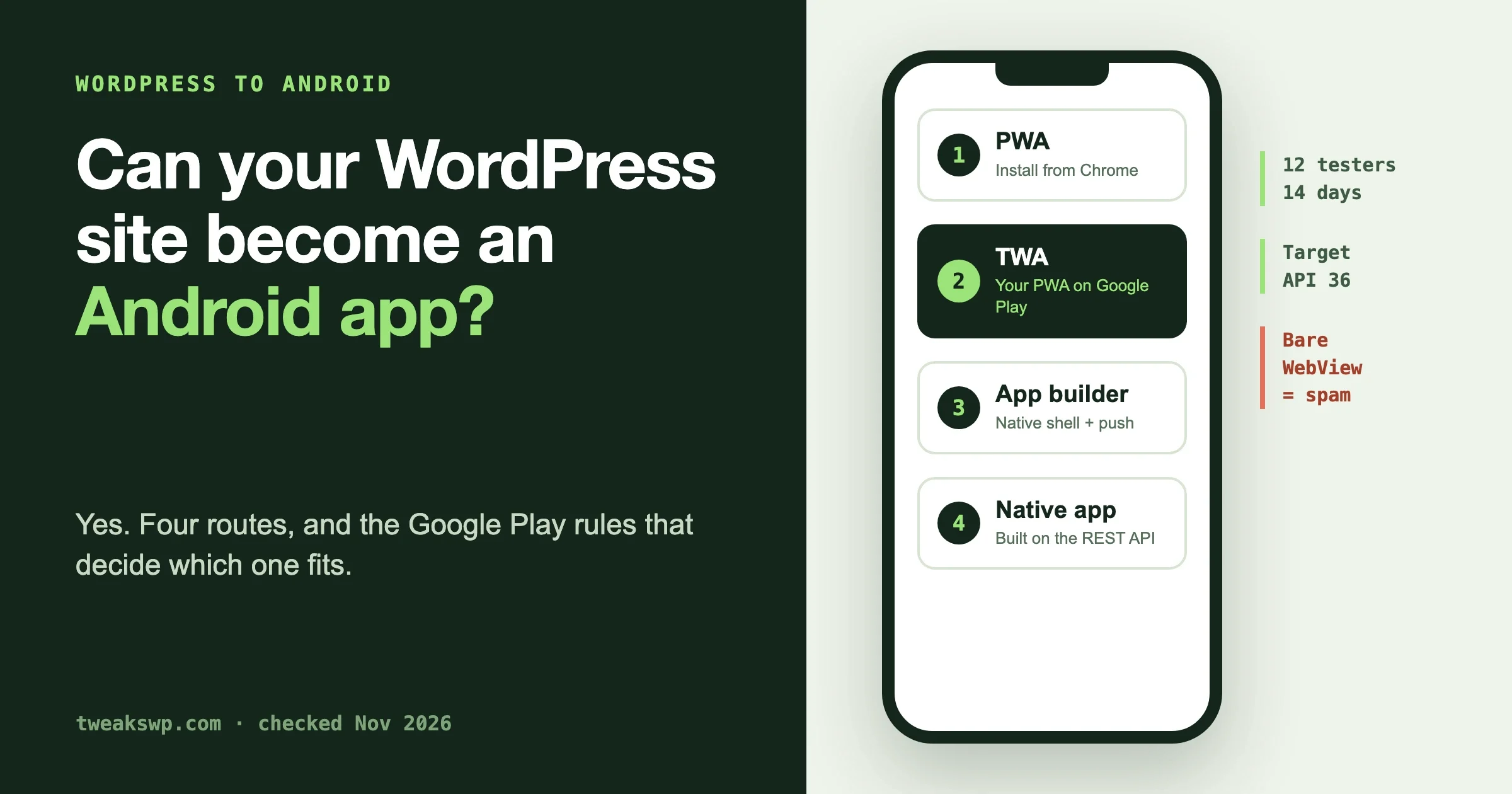
Yes, you can create an Android app from a WordPress site, and you do not have to rebuild the site to do it. There are four honest routes: make the site a progressive web app that people install from Chrome, package that web app for Google Play as a Trusted Web Activity, use an app builder that wraps the site with native extras, or build a native app that reads your content through the WordPress REST API. What you cannot do any more is paste your URL into a bare WebView, upload it to Google Play and expect it to stay there, because Google treats a plain website wrapper as spam.
The right route depends on what your visitors need from an app that they cannot already get in the browser. Our team checked every Google Play rule, Android requirement, plugin figure and code sample in this guide on 18 November 2026, against WordPress 7.1.4 and the official Google, Android and WordPress documentation linked in each section.
This page has no recorded Search Console queries yet, so the headings follow the questions site owners actually ask before they spend money on an app.
Can you turn a WordPress site into an Android app?
You can, and the four routes differ mostly in how much of the app is still your website. A PWA and a Trusted Web Activity are your website, running in Chrome, with app behaviour added. An app builder is your website inside a native shell, with native menus, push notifications and some screens built from your content. A native REST API app is a separate piece of software that only uses WordPress as its database and admin panel.
Route | Play Store listing | What the user sees | Who maintains it |
|---|---|---|---|
Progressive web app (PWA) | No, installed from the browser | Your site, full screen, with an icon on the home screen | You, through a WordPress plugin |
Trusted Web Activity (TWA) | Yes | Your PWA in full-screen Chrome, no browser bar | You, plus a small Android project |
App builder or WebView wrapper | Yes | Your pages inside a native shell with native menus and push | The builder service, on a subscription |
Native app on the REST API | Yes | Native screens that load your posts, products or members as data | A mobile developer or agency |
If your goal is “an icon on my customers’ phones”, a PWA usually gets you there in an afternoon. If your goal is “a listing on Google Play with push notifications”, look at a TWA or a builder. If your goal is an app that works offline, uses the camera, handles members and feels like a real phone app, you are in native territory.
What does Google Play allow, and what gets rejected?
Google Play allows apps built on web content, including apps made from your own WordPress site, as long as the app offers more than the website already does and you own or administer that website. It rejects two things that WordPress app shortcuts often produce: a wrapper around someone else’s site, and an app so thin that it adds nothing.
The relevant rules sit in two Play Console policy pages. The Spam policy has a section called Webviews and Affiliate Spam, which bans apps whose primary purpose is to “provide a webview of a website without permission from the website owner or administrator”. Its own example is a shopping deals app that simply shows Google Shopping. The Functionality, Content, and User Experience policy bans apps with limited functionality and content, and separately bans apps that install but do not load, or load but do not respond.
Google has been direct about website wrappers for years. In an October 2020 post on the Android Developers Blog, the Play policy team wrote that it sees a large volume of submissions “that are just webviews of existing websites” and that such apps “are removed from Play”. Apple is stricter still: App Review Guideline 4.2 says an app should include features, content and UI that go beyond a repackaged website.
What counts as “more than the website”?
Nothing in the policy lists required features, so we judge it the way a reviewer would: does the app do something a home screen bookmark cannot? Things that usually tip the balance:
- Push notifications for something the user asked to follow, such as an order, a course, a reply or a booking.
- An offline screen or offline reading for content the user already opened.
- Native navigation (a bottom tab bar, a back button that behaves like Android) instead of your desktop menu squeezed onto a phone.
- Sign-in that persists, so members are not asked for a password every time they open the app.
- Device features that make sense for your site: camera upload for a community, a barcode scan for a shop, a downloaded lesson for a course.
A blog that publishes twice a month and has none of these is the case Google describes in its policy. For that site, the honest answer is a PWA and a good mobile theme, not a Play listing.
Is a progressive web app enough for most WordPress sites?
For many content sites, shops and small communities, yes. A progressive web app is your existing site with a web app manifest and a service worker, served over HTTPS. Chrome on Android offers to install it, it gets an icon and opens full screen, and it can send web push notifications on Android once the visitor allows them. There is no store review, no developer account and no separate codebase.
Chrome’s current install criteria are short. The site must be served over HTTPS, and the manifest must include a name or short_name, icons at 192px and 512px, a start_url, and a display value of fullscreen, standalone, minimal-ui or window-controls-overlay. The visitor also has to interact with the page before Chrome shows its install prompt.
WordPress core does not output a manifest or service worker by itself, so most sites use a plugin. Here is what the main options looked like on WordPress.org on 18 November 2026:
Plugin | Active installs | Rating | Last updated | Tested up to |
|---|---|---|---|---|
40,000+ | 4.6 of 5 (225 ratings) | 19 Oct 2026 | 7.1.4 | |
10,000+ | 4.6 of 5 (230 ratings) | 13 Oct 2026 | 7.1.4 | |
20,000+ | 4.3 of 5 (27 ratings) | 10 Apr 2025 | 6.8.12 |
The PWA feature plugin from GoogleChromeLabs is worth a note. It was built as a set of building blocks for core, not as a polished product, and its last release is from April 2025, tested only to WordPress 6.8. It still works on many sites, but if you want regular updates, one of the two maintained plugins is the safer pick.
Where a PWA falls short
- No Play Store listing. Some customers only look for apps in the store, and some businesses need the store badge for credibility.
- Caching needs care. A service worker that caches too aggressively can show logged-in members stale pages or someone else’s cart fragment if the rules are wrong. Our guide to WordPress caching layers explains which cache sits where, which helps when you set offline rules.
- Only one service worker wins. Two plugins that each register their own service worker on the same scope will fight. Pick one PWA plugin and check that your push notification plugin works with it.
- iPhone users get less. Safari supports home screen web apps and web push, but its install flow is manual through the Share menu, and the experience is more limited than on Android.
How do you put a WordPress PWA on Google Play?
You wrap the PWA in a Trusted Web Activity. A TWA is a tiny Android app that opens your site in the user’s own Chrome, full screen, without the address bar. Because the content is still rendered by Chrome, logins, cookies, payments and updates work exactly as on the website, and every change you publish in WordPress shows up in the app straight away.
Two things make a TWA different from a plain WebView. First, Chrome checks that you own the site through Digital Asset Links; if the check fails, users see a browser bar at the top and the app looks broken. Second, Chrome’s TWA documentation says the web app must meet the same add-to-home-screen requirements as a PWA, so a TWA is only as good as the PWA under it.
The usual tool is Bubblewrap, Google’s command-line tool for generating and building TWA projects. Its README lists Node.js 18 or newer as a requirement, and the latest release on GitHub was 1.27.0 on 9 October 2026. These are the core commands, checked on 18 November 2026:
# Install the Bubblewrap CLI (do not run with sudo).
npm i -g @bubblewrap/cli

# Create the Android project from your live web app manifest.
bubblewrap init --manifest https://example.com/manifest.json

# Build a signed app bundle and APK.
bubblewrap build

# After the first upload to Play, add Google's app signing fingerprint.
bubblewrap fingerprint add <SHA-256 from Play Console> --name=play-signing
bubblewrap fingerprint generateAssetLinks
The last command produces the file Chrome looks for. You publish it at https://example.com/.well-known/assetlinks.json, served as JSON. A minimal file looks like this, with your own package name and fingerprints:
[
  {
    "relation": ["delegate_permission/common.handle_all_urls"],
    "target": {
      "namespace": "android_app",
      "package_name": "com.example.twa",
      "sha256_cert_fingerprints": [
        "PLAY_APP_SIGNING_KEY_SHA256",
        "UPLOAD_KEY_SHA256"
      ]
    }
  }
]
On WordPress, the .well-known folder belongs in the web root, the folder that serves your homepage (on most installs, the one that also holds wp-config.php). Upload the file there through SFTP or your host’s file manager rather than through the Media Library, which would give it the wrong path. Then load the URL in a private browser window and confirm it returns the JSON, not a 404 page or a redirect to your homepage.
If your site has a PWA plugin already, its manifest URL is usually linked in the page head. Open your homepage, view the source, and search for rel="manifest" to find it before you run bubblewrap init.
Do app builder plugins and WebView wrappers still work?
They work when they add native features on top of your pages, and that is what the established builders sell. They connect to your site through a WordPress plugin, build native menus and screens from your posts, products and pages, add push notifications, and handle the Android build for you. You pay a subscription, and the builder keeps the app current with Google’s yearly requirements.
The figures below come from the WordPress.org plugin API on 18 November 2026. Prices change often and none of these vendors publishes a single simple price, so check the vendor’s own pricing page before you commit.
Builder | Connector plugin | Active installs | Rating | Last updated |
|---|---|---|---|---|
AppMySite | 7,000+ | 4.3 of 5 (138) | 21 Sep 2026 | |
WPMobile.App (formerly WPApp.Ninja) | 3,000+ | 4.8 of 5 (162) | 19 Oct 2026 | |
AppPresser | 900+ | 3.7 of 5 (53) | 16 Nov 2026 | |
MobiLoud | Done-for-you service | Not on WordPress.org | Not listed | Not listed |
AndroApp | 300+ | 4.5 of 5 (65) | 15 Dec 2022 |
One correction to older guides, including the earlier version of this page: AndroApp has not been updated since December 2022 and is tested only up to WordPress 6.1. An app builder has to keep pace with Android’s target API rules every year, so we would not start a new app on it.
What to check before you pick a builder
- Your plugins. Membership, LMS, booking and community plugins often render screens with their own JavaScript. Ask the builder for a live demo of your login, checkout and member pages, not their sample store.
- Who owns the store listing. Publish under your own Google Play developer account so you keep the listing, reviews and users if you change builders later.
- What happens when you stop paying. Most builders stop updating the app; some stop the app from loading. Ask in writing.
- Annual Android updates. Ask how quickly they shipped builds for the 31 August 2026 target API deadline.
- Push notification costs. Some plans cap notifications or devices.
When should you build a native app on the WordPress REST API?
Build native when the app has to do real work on the phone: offline access to downloaded content, camera or file uploads, rich member profiles, messaging, or screens that would be awkward as web pages. In that model WordPress stays your admin panel and database, and the app talks to it through the WordPress REST API, which has been part of core since WordPress 4.7.
Public content is available without signing in. This request returns your latest five published posts as JSON, and it is the same data a native app would turn into a list screen:
# Public read: latest five posts, only the fields the app needs.
curl "https://example.com/wp-json/wp/v2/posts?per_page=5&_fields=id,date,link,title,excerpt"
Anything personal needs authentication. WordPress has shipped Application Passwords since version 5.6, according to the REST API authentication handbook. A user creates one on their profile screen, and the app sends it with each request over HTTPS as Basic Auth. The handbook notes that cookie authentication only applies when the REST API is used inside WordPress itself, so a separate app needs Application Passwords or a token plugin such as JWT Authentication for WP REST API (50,000+ installs, updated 6 November 2026).
# Authenticated read: the current user's own profile.
# Create the password under Users > Profile > Application Passwords.
curl --user "member-login:abcd efgh ijkl mnop qrst uvwx" \
  "https://example.com/wp-json/wp/v2/users/me?context=edit"
Three practical points our team has learned from building REST endpoints for mobile apps:
- Do not hand the app more than it needs. Use
_fieldsor custom endpoints so the app downloads what one screen shows, not entire post objects. On a phone connection, this is the difference between a quick list and a spinner. - Check what the REST API already exposes. The default
/wp/v2/usersroute lists author names and login slugs. Our guide to every way WordPress hands out usernames covers what to lock down before you point an app at the API. - Push needs its own pipeline. Native Android push goes through Firebase Cloud Messaging, and since Android 13 (API level 33) users must grant the POST_NOTIFICATIONS runtime permission before the app can show notifications. New installs start with notifications off, so ask at a moment where the value is obvious.
Is a native app worth it for a WordPress site?
Only when the app is a product in its own right. A native app is a second codebase with its own releases, store reviews, crash reports and yearly Android updates, on top of the WordPress site you already maintain. For a community, a course platform or a members-only service that people open every day, that cost often pays back. For a brochure site, it does not.
This is work our team at Wbcom Designs does: we build the WordPress side of mobile apps for community, membership and learning sites, meaning REST endpoints with token sign-in and permissions that match the website, as described on our WordPress REST API development page. The honest limits: it is custom development quoted per project after a call, it needs the app screens agreed up front, and someone has to maintain the app every year after launch. If a PWA or a builder covers your needs, start there.
What does it take to publish an Android app on Google Play in 2026?
Whichever route you choose (other than a plain PWA), the Google Play steps are the same. These are the current rules, checked on 18 November 2026:
- Create a developer account. Google charges a US$25 one-time registration fee and runs identity verification, which can ask for a government ID and a card in your legal name. Choose an organisation account if the app belongs to a business.
- Pass the testing requirement if you are a new personal account. Personal accounts created after 13 November 2023 need at least 12 testers opted in to a closed test for 14 continuous days before they can apply for production access. Testers who drop out early do not count. Plan two to three weeks for this.
- Upload an Android App Bundle. Since August 2021, new apps must be published as an Android App Bundle (an .aab file), not a bare APK. Bubblewrap and the builders produce one for you.
- Meet the target API level. From 31 August 2026, new apps and updates must target Android 16 (API level 36) or higher, with an extension available to 1 November 2026. Existing apps must target Android 15 (API level 35) to stay visible to new users on newer devices.
- Fill in the store listing and policy forms. That means screenshots, a privacy policy URL, the Data safety form (declare what data your WordPress site collects through the app), a content rating questionnaire, and target audience.
- Submit for review. Reviews can take days for a new account. Keep the app usable without a login so the reviewer can see real content, or give them a test account in the App access section.
If you plan to distribute outside Google Play, for example sending members an APK directly, note that Android developer verification started on 30 September 2026 in Brazil, Indonesia, Singapore and Thailand for certified devices, and Google says it will expand globally in 2027. Apps from unverified developers will need an advanced install flow, so registering your identity is now part of shipping any Android app.
How much does it cost to make an Android app from WordPress?
The only fixed number is Google’s US$25 registration fee. Everything else depends on the route, and we would rather show you where the costs sit than quote prices that change every quarter.
Route | Upfront effort | Recurring cost | Main hidden cost |
|---|---|---|---|
PWA | A few hours with a free plugin | None beyond hosting | Testing caching rules for logged-in users |
TWA | A day or two, plus 14 days of closed testing | Yearly target API rebuild | Digital Asset Links and signing keys |
App builder | Days, mostly design and menus | Monthly or yearly subscription | Lock-in if you change provider |
Native app | Weeks to months of development | Developer time for each Android and WordPress update | Two codebases to keep in step |
Which option should you choose?
Use this as a starting point, then test the cheaper option first. Moving from a PWA to a TWA later costs almost nothing, because the TWA is built from the same PWA.
Your situation | Our suggestion |
|---|---|
Blog or news site, readers mainly from search | PWA, and invest in a fast mobile theme |
Shop selling physical products | PWA first; TWA if you want the Play listing |
Membership, course or community site with daily users | App builder to test demand, native app once it proves itself |
App needs offline content, camera or messaging | Native app on the REST API |
Site you do not own or run | Do not build it; Play bans webviews of other people’s sites |
Shops in particular should read the Google Play Payments policy first. Physical goods and services, such as clothing or event tickets for real venues, must not use Google Play’s billing system, so a WooCommerce checkout inside the app is fine. Digital goods and subscriptions sold inside the app generally must use Play billing, apart from programmes for alternative billing in eligible countries. Our guide on whether WordPress can do ecommerce covers the store side.
Common mistakes people report
These come up again and again in support forums and developer write-ups. We read each source on 18 November 2026.
- The browser bar never goes away. A developer who shipped a PWA to Google Play as a TWA described on DEV Community that the app showed a bar instead of running full screen because assetlinks.json listed the upload key fingerprint, not Google’s app signing key. The CDN also served the file as plain text, and Chrome cached the failed check until they cleared Chrome’s data on the test phone. Chrome’s docs explain why: with Play App Signing, the two keys have different fingerprints.
- Surprised by the closed-testing gate. The same write-up lists the 12 testers for 14 days rule as a launch delay. New personal accounts cannot skip it, so line up testers before the app is finished.
- Members logged out every time they close the app. In a 2025 WPMobile.App support thread, a site owner reported exactly this; the fix was making sure members ticked “Remember me” at login, because the default WordPress session cookie ends with the browser session.
- An update rejected for a permission the app no longer uses. In a mid-2026 thread on the same plugin, Google rejected an update under the Photo and Video Permissions policy. The plugin author explained the permissions had been gone for years and an old version was still published on a testing track. Clean out old releases on every track, not only production.
- Expecting in-app payments to be simple. A 2025 thread asked whether a membership site could take subscription payments in its app; the plugin author said that was still not possible with the plugin. Store rules for digital subscriptions differ from physical goods, so plan payments before you build.
- Wrapping a site you do not run. Google’s own example of webview spam is an app that shows someone else’s shopping site. Building an app for a client is fine; building one for a site whose owner has not agreed is not.
What should you fix on the WordPress site first?
Every one of these routes inherits your site’s problems, so a slow or fragile site makes a slow or fragile app. Before you build, check these on the live site:
- HTTPS everywhere, with no mixed content warnings. PWAs, TWAs and Application Passwords all depend on it.
- Mobile speed on a real phone, not only a desktop score. An app that takes four seconds to show the first screen gets uninstalled.
- Login and checkout on a narrow screen, including password reset emails that open the right page.
- A tested update process. A plugin update that breaks the site now also breaks the app for everyone at once. Our guide to updating WordPress safely covers staging and rollback.
Frequently asked questions
Can I make an Android app from my WordPress site for free?
A PWA is free: a maintained plugin, your existing hosting, and Chrome’s install prompt. A TWA costs the US$25 Google Play fee plus your time. App builders and native apps carry ongoing costs.
Will the app update when I publish a new post?
With a PWA, a TWA or most builders, yes, because the app loads your live site or its data. A native app also shows new posts immediately, since it reads them from the REST API. Only changes to the app itself, such as new screens, need a new store release.
Can I use the same app on iPhone?
A PWA works on iPhone through Safari’s Add to Home Screen. A TWA is Android only. Most builders and native frameworks produce both an Android and an iOS app, but Apple’s review is stricter about website wrappers.
Can my WooCommerce store run inside the app?
Yes. For physical goods, a normal WooCommerce checkout is allowed under Google Play’s Payments policy. Test the payment gateway’s redirects and 3-D Secure screens inside the app before launch.
Is it safe to point a mobile app at my WordPress REST API?
It is, if you keep the defaults in mind. Public routes are readable by anyone already, the app should only get Application Passwords for the users who sign in, and custom endpoints need a proper permission_callback. Review what is public before launch, not after.
Plugins we build and run
We maintain these ourselves, which is why we can support them on your site.
- BuddyNextThe self-hosted community engine for WordPress
- BuddyXFree community theme, Pro when you outgrow it
- ReignPremium community theme. Add pieces, build anything
- JetonomyCommunity forum and Q&A for WordPress
- EventonomyEvents and RSVPs for WordPress communities
- LearnomyCourses and learning communities on WordPress
- ListoraDirectories and listings your members can browse
- SnipShareCode sharing built for developer communities
- WB Ad ManagerAd placements that turn traffic into revenue
- WP Career BoardA job board your community actually uses
- WP Sell ServicesSell services with offers, orders, and payouts
- MediaVersePhotos, video, and media albums for members
- WB GamificationPoints, badges, and rewards that keep members active
- Product RoadmapPublic roadmaps with voting your users trust






Related Posts
LiteSpeed Cache Vulnerability CVE-2026-93389: Check Your Version and What Was Exposed
Freemius SDK Stored XSS: How to Find Every Bundled Copy on a Client Site (Anything Under 2.13.5)