How to Uninstall WordPress DreamHost?
Remove WordPress from DreamHost in two steps: delete the files, then the database. Back up first and keep your email and domain safe.
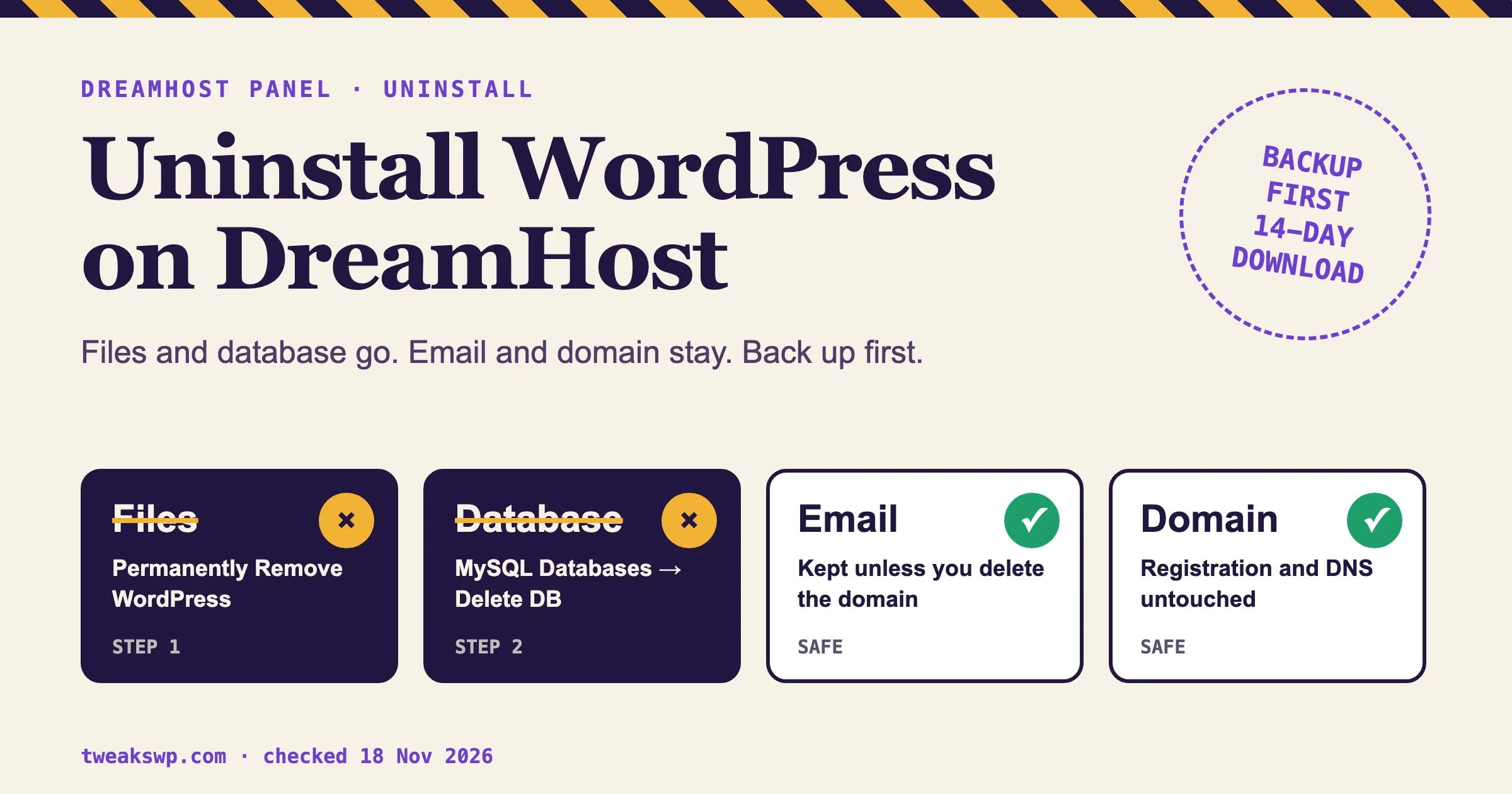
To uninstall WordPress on DreamHost, back the site up first, then open Manage Websites, click Manage on the site, open the WordPress tab, scroll to Permanently Remove WordPress and click Remove, then Proceed with Removal. That deletes the files. It does not delete the database, so finish on the MySQL Databases page and click Delete DB next to the site’s database.
Your domain and your email are not touched by either step. They only go away if you delete the domain itself or cancel hosting without keeping email, which is the mistake this guide is built to help you avoid. Our team checked every panel label and behaviour below against DreamHost’s own help center on 18 November 2026; the DreamHost articles we used were last updated between July and October 2026.
This page has no recorded Search Console queries yet, so the headings follow the questions people ask when they want WordPress gone from a DreamHost account without breaking anything else.
What does “uninstall WordPress” actually mean on DreamHost?
DreamHost has several buttons that sound alike and do very different things. Some only stop DreamHost from managing the install. Some delete files. One deletes your email. Before you click anything, match what you want to the right tool:
Panel action | Deletes WordPress files? | Deletes the database? | Email and domain |
|---|---|---|---|
Remove DreamHost Management (WordPress tab) | No. Files stay and the site keeps working | No | Untouched |
Permanently Remove WordPress (WordPress tab) | Yes, everything in the install folder | No | Untouched |
Delete DB (MySQL Databases page) | No | Yes | Untouched |
Reset WordPress then Reinstall | Overwrites your content with a fresh install | Content is overwritten | Untouched |
Set to DNS Only (Settings tab) | No (except on DreamPress, where files are deleted) | No | Email keeps working; web records removed |
Permanently Delete Domain (Settings tab) | No | No | All email addresses and their mail are deleted, plus subdomains |
Cancel a Shared Hosting plan (Manage Account) | Hosting ends immediately | Not stated by DreamHost | Email kept only if you choose a paid email plan; registration stays |
Sources for every row: DreamHost’s articles on deleting a DreamHost WordPress install, resetting a WordPress installation, setting a domain to DNS Only, deleting a domain and deleting a Shared Hosting plan, all read on 18 November 2026.
So a full uninstall is two actions, files then database. Everything else in that table is either a softer option or a much bigger one.
One more case first: if your site is on a DreamPress plan, DreamHost sends you to separate instructions for deleting DreamPress or moving off a DreamPress plan. The steps below are for WordPress on Shared hosting.
What should you back up before you uninstall WordPress on DreamHost?
Everything you might want back: the files, the database, and, if you are closing the account, the email. Deletion on a web server has no recycle bin. DreamHost does keep some automatic copies, but its own help center says plainly that they are not guaranteed, so treat them as a last resort rather than your backup.
Option 1: a full account backup from the panel
This is the easiest route if you are closing the account or removing several sites. DreamHost’s account backup article lists the steps:
- Go to the Manage Account page.
- Scroll to Back Up Your Account and click Create a Backup.
- Click Back me up! and wait for the email that says it is finished. Time depends on how much data you have.
- Open the backup page from that email and download each file. There is no bulk download, so you click them one at a time.
The backup covers your users (website files, as .tar.gz archives), your databases (as .sql.gz) and your mailboxes. The files stay available to download for 14 days, so download them straight away and keep them somewhere other than DreamHost.
Option 2: a manual backup of one site
For a single site, DreamHost’s manual backup guide takes two parts. Download the site folder with an FTP or SFTP client such as FileZilla, compressing it on the server first if it is several gigabytes. Then export the database from phpMyAdmin (open it from the MySQL Databases page, select the database, use the Export tab). If you also use DreamHost email, back up the mailboxes separately.
Option 3: a backup over SSH with WP-CLI
DreamHost says WP-CLI is installed on all of its servers. If you have a shell user, these commands give you a database dump and a compressed copy of the site in your home folder. Swap example.com for your site’s folder name. Checked on 18 November 2026 against the WP-CLI command reference.
# Go to the site folder
cd ~/example.com

# Export the database to a file in your home directory
wp db export ~/example-com-db-2026-11-18.sql

# Archive the whole site folder (run from your home directory)
tar -czf ~/example-com-files-2026-11-18.tar.gz -C ~ example.com

# Quick sanity checks before you delete anything
head -n 5 ~/example-com-db-2026-11-18.sql
tar -tzf ~/example-com-files-2026-11-18.tar.gz | head
Then download both files to your computer. A backup that only lives in the account you are about to delete is not a backup.
If you prefer a plugin, our roundup of WordPress backup plugins compares the options. For removal, any plugin that gives you a downloadable archive of files plus database is enough.
What DreamHost keeps on its own, and for how long
Automatic copy | How far back | Guaranteed? |
|---|---|---|
Website files | Generally about 2 weeks, offered as Most Recent, Mid-Range and Oldest | No |
MySQL databases | Backed up daily; “in general” five days available | No |
Panel account backup you create | Downloadable for 14 days | It is your copy; download it |
Sources: How do I restore my website? and Restore a database in the panel, read on 18 November 2026. Both articles state DreamHost makes no guarantee those backups exist.
How do you find where WordPress is installed and which database it uses?
Check this before you delete, because the location decides how much gets wiped. DreamHost’s removal guide puts it bluntly: if WordPress sits in the main web folder, removing it deletes everything in that folder and every folder under it.
- Go to the Manage Websites page.
- Click Manage for the site. In Grid view the button is at the bottom of the site’s box; in List view it is at the far right of the domain name.
- Click the WordPress tab.
- If there is more than one install, pick yours from the Managing dropdown.
Now read the path DreamHost shows:
- Just the domain, such as example.com: WordPress is in the primary web directory. Removing it also deletes anything else under that folder, such as
example.com/imagesor a second app inexample.com/shop. - The domain plus a folder, such as example.com/blog: WordPress is in a subdirectory. Only the files in that folder are deleted, the empty folder stays, and nothing above it is touched.
If the primary folder holds something you want to keep, move it out first, or delete the WordPress files by hand instead (covered further down).
Find the database name before you need it
A DreamHost account often has several databases with similar names, and the panel will happily delete the wrong one. The name your site uses is in wp-config.php in the site folder, on the DB_NAME line. With WP-CLI you can read it directly:
cd ~/example.com
wp config get DB_NAME
wp config get DB_HOST
wp config get table_prefix
Write those three values down. DB_HOST is the database hostname (for example mysql.example.com), and table_prefix tells you which tables belong to this site if two installs ever shared one database. If you are curious what is inside, our guide to the tables in a default WordPress database lists them. Checked on 18 November 2026.
How do you delete a DreamHost one-click WordPress install?
If WordPress was installed with DreamHost’s installer (what older guides call a one-click install), the panel removes the files for you. These are the steps from DreamHost’s Delete a DreamHost WordPress install article, last updated 16 July 2026:
- Make sure your backup is downloaded and opens.
- Go to Manage Websites and click Manage for the site.
- Open the WordPress tab and pick the install from the Managing dropdown if there are several.
- Confirm the path one last time (primary folder or subdirectory).
- Scroll down to Permanently Remove WordPress and click Remove.
- Read the warning, then click Proceed with Removal.
The files are now gone and the install leaves the panel list. The site will stop loading, but the database is still sitting on the MySQL server, which brings us to step two.
What “Remove DreamHost Management” does instead
On the same tab there is a gentler button. Remove DreamHost Management only takes the site off DreamHost’s managed list. No files are deleted, the site keeps running, and from then on you are responsible for its updates. It is useful if you want to manage updates yourself. It is not an uninstall, and people who click it expecting the site to disappear are often surprised to find it still live.
How do you delete the WordPress database on DreamHost?
Deleting the files never deletes the database. DreamHost spells this out in its removal guide: the database stays in your panel until you remove it.
- Go to the MySQL Databases page in the panel.
- Find the database whose name matches the
DB_NAMEyou wrote down. - Click Delete DB to the right of it and confirm.
Two things are worth checking on the same page. First, whether the database user is used by any other database; if not, you can remove it so an old password is not left lying around. Second, whether the hostname (such as mysql.example.com) is shared by other databases you still use. Leave anything you are not sure about.
If you might want the content back later, stop here for a week or two and keep the database while you confirm the backup restores. An unused database costs nothing on Shared hosting and is the cheapest insurance you have.
How do you remove WordPress that was installed by hand?
If you uploaded WordPress yourself, or installed it with WP-CLI, the WordPress tab may not list it. You delete it the same way you would on any host: files, then database.
- Back up as above and download the backup.
- Connect with SFTP (DreamHost’s backup guide links to the FTP credentials page) or SSH.
- Open the site folder and look before you delete. A WordPress install contains
wp-admin,wp-content,wp-includesand a set ofwp-*.phpfiles plusindex.php,xmlrpc.phpand usually.htaccess. - Delete those WordPress files and folders. If WordPress was the only thing in the folder, you can empty it entirely.
- Delete the database on the MySQL Databases page as described above.
Over SSH, list first, then remove. These commands only touch a blog subfolder; change the path to match yours, and never run them on a folder you have not listed and checked.
# Look before you delete
ls -la ~/example.com/blog

# Remove the WordPress install in that subfolder
rm -rf ~/example.com/blog/wp-admin ~/example.com/blog/wp-includes ~/example.com/blog/wp-content
rm -f ~/example.com/blog/wp-*.php ~/example.com/blog/index.php ~/example.com/blog/xmlrpc.php ~/example.com/blog/.htaccess

# Confirm what is left
ls -la ~/example.com/blog
Leave .htaccess alone if another app in the same folder relies on it. Checked on 18 November 2026.
Will uninstalling WordPress delete my email or my domain?
No, not on its own. Removing WordPress files and deleting the database touch only the website. Your DreamHost mailboxes, your domain registration and your DNS records stay exactly as they were. Visitors simply get an empty folder or an error where the site used to be.
Email is at risk in only two places, and both are bigger actions than an uninstall:
- Permanently Delete Domain on the Settings tab. DreamHost’s deleting a domain article says this removes the website from Manage Websites, all email addresses and their content, the database hostname and every subdomain. It cannot be undone. Oddly, it does not delete the files or databases, or the domain registration.
- Cancelling the Shared Hosting plan. According to DreamHost’s plan cancellation guide (updated 20 October 2026), if you have active mailboxes and no other email plan, the panel asks whether to keep them. Choosing Keep Emails Active adds a paid email plan to your cart; otherwise the email goes with the hosting.
Domain registrations survive both. DreamHost keeps registrations active for the rest of their term even after hosting is cancelled, and you manage renewal or transfer separately.
How do you take the site offline but keep email working?
Use DNS Only. It removes the web records so the domain no longer points at a website, while email keeps working and your hosting plan stays in place. It is the right move if you have deleted WordPress and do not want visitors hitting an empty folder, or if you are building the next site somewhere else. Steps from DreamHost’s DNS Only article, updated 16 July 2026:
- If the site has an SSL certificate, delete it first. DreamHost notes the DNS records will not be removed while a certificate is attached.
- Go to Manage Websites, click Manage, open the Settings tab.
- Under Non-Hosting Options, expand Set to DNS Only and click Set to DNS Only.
- Confirm with Yes, Set to DNS Only.
This removes the root, www, ssh and ftp A records and keeps any custom DNS records you created. Your nameservers must point at DreamHost for it to work. On a normal Shared plan the files are kept, so delete them separately if you want them gone; on DreamPress, setting DNS Only deletes the files.
If you want to keep a subdomain online, do not delete the primary domain. DreamHost recommends setting the primary to DNS Only instead.
How do you start over with a fresh WordPress on DreamHost?
If your goal is a clean slate rather than no site at all, you do not need to uninstall. DreamHost’s reset tool works on sites created with its WordPress installer:
- Back up first, because the reset overwrites your content.
- Go to Manage Websites, click Manage, open the WordPress tab and choose the install.
- Scroll to Reset WordPress and click Reinstall.
- Review the domain, click Next, choose the Liftoff builder or Custom Installation, click Next.
- Type the domain name to confirm and click Confirm Reinstall.
If you installed WordPress manually and want to start again, delete files and database as above and then install fresh. Our guide on setting up your first WordPress site walks through the settings worth changing on day one.
What should you do first if you are moving to another host?
Move first, delete last. Uninstalling WordPress on DreamHost before the new host is serving the site is the single most common way people lose a site during a migration.
- Take a full backup and download it.
- Set up the site at the new host and import the backup. If the new host uses cPanel, our guide to installing WordPress on cPanel covers the setup side.
- Test the new copy using the host’s temporary URL or a hosts-file entry.
- Point DNS at the new host. If DreamHost still runs your email, change only the web records (the root and www A records) and leave the MX records alone, or set the domain to DNS Only and add custom records.
- Wait until the new site is serving for everyone, which can take up to a couple of days after a DNS change, and keep an eye on contact forms and orders in that window.
- Only then remove WordPress and the database on DreamHost, and cancel the plan if you no longer need it, choosing Keep Emails Active if DreamHost hosts your mail.
DreamHost keeps a guide on transferring website hosting to another company that covers the account side.
How do you check that WordPress is really gone?
Do not trust the panel message alone. Check from the outside and the inside.
- From a browser in a private window, load the home page and
/wp-login.php. You should get an empty directory, an error page or DreamHost’s parked page, not your old site. Browser and CDN caches can show the old site for a while, so test from another device or network too. - From a terminal, ask for the login page directly.
- In SFTP, open the site folder and confirm no
wp-files are left, and that subdirectories you wanted to keep are still there. - On the MySQL Databases page, confirm the database is gone (or still there, if you chose to keep it for a while).
- In Manage Websites, confirm email is still listed for the domain if you rely on it, and send yourself a test message.
# Expect a 404 or a non-WordPress response, not 200 from WordPress
curl -sI https://example.com/wp-login.php | head -n 1

# Check DNS still points where you expect (web and mail)
dig +short example.com A
dig +short example.com MX
Search engines will keep listing old URLs for a while after the site is gone. That is normal and fades on its own as they recrawl and find nothing.
Common mistakes people report
These come up again and again in WordPress.org support threads and in DreamHost’s own warnings. Checked on 18 November 2026.
- Clicking a removal option and finding the site still live. One site owner deleted three years of posts and still could not get the site off the web; the fix offered was to remove the root and www A records in the DreamHost DNS settings so the domain stopped pointing at the site. Today’s equivalent is Set to DNS Only, and DreamHost notes that Remove DreamHost Management deletes no files at all. (WordPress.org support, July 2015; DreamHost removal guide)
- Deleting the domain instead of the install. A user who deleted a domain from the DreamHost dashboard and re-added it found the files still on FTP but the site showing “Error establishing a database connection”; restoring the database from the panel was the suggested way back. Deleting a domain also deletes its email, which is why it is the wrong tool for a website uninstall. (WordPress.org support, September 2011; DreamHost: deleting a domain)
- Forgetting the database. The oldest version of this question on the forums got the answer that still holds: delete all the WordPress files, then delete the database in phpMyAdmin or drop its tables. DreamHost’s current guide repeats that deleting files leaves the database in place. (WordPress.org support, January 2008)
- Not noticing a second install. A site owner kept seeing an old site at a blog address after removing what they thought was the only install; there were two installs on the account, and removing the second one from the installer cleared it. Use the Managing dropdown and check every subdomain. (WordPress.org support, April 2010)
- Wiping subfolders with a primary-folder install. Removing WordPress from the main web directory deletes every subdirectory under it, including other apps or files you parked there. Check the path on the WordPress tab first. (DreamHost removal guide, updated July 2026)
- Set to DNS Only seems to do nothing. If the site still has an SSL certificate attached, DreamHost will not remove the DNS records; delete the certificate first. (DreamHost DNS Only guide, updated July 2026)
Frequently asked questions
Does uninstalling WordPress on DreamHost cancel my hosting plan?
No. Removing WordPress, deleting the database and even setting DNS Only all leave the plan running and billing. To stop paying, cancel the plan on the Manage Account page.
Can I get my site back after I delete it?
Sometimes. DreamHost generally keeps about two weeks of file backups and around five days of daily database backups, and you can restore them from the panel, but it does not guarantee they exist. Your own downloaded backup is the only copy you can count on.
Will my email stop working if I delete WordPress?
No. Email only goes away if you delete the domain or cancel hosting without choosing to keep it. Deleting files and the database leaves mailboxes alone.
How long does the removal take?
The panel removal runs in a few minutes. The account backup before it can take longer, depending on how much data you have, and DreamHost emails you when it is ready.
Can I keep the domain and point it somewhere else?
Yes. The domain registration is separate from hosting. Set the domain to DNS Only and add custom records for the new service, or change its nameservers to the new host.
Do I need to delete plugins or themes first?
No. Removing the install deletes everything in the folder, plugins and themes included. If a plugin stored data outside WordPress (an external backup service or a CDN account), close that account separately.
If the reason you are removing WordPress is a hack or a broken update rather than a move, read our guide on why a WordPress site needs a business continuity plan before you start again. A tested backup and a written recovery plan are what make the next problem a short one.
Plugins we build and run
We maintain these ourselves, which is why we can support them on your site.
- BuddyNextThe self-hosted community engine for WordPress
- BuddyXFree community theme, Pro when you outgrow it
- ReignPremium community theme. Add pieces, build anything
- JetonomyCommunity forum and Q&A for WordPress
- EventonomyEvents and RSVPs for WordPress communities
- LearnomyCourses and learning communities on WordPress
- ListoraDirectories and listings your members can browse
- SnipShareCode sharing built for developer communities
- WB Ad ManagerAd placements that turn traffic into revenue
- WP Career BoardA job board your community actually uses
- WP Sell ServicesSell services with offers, orders, and payouts
- MediaVersePhotos, video, and media albums for members
- WB GamificationPoints, badges, and rewards that keep members active
- Product RoadmapPublic roadmaps with voting your users trust














Related Posts
LiteSpeed Cache Vulnerability CVE-2026-93389: Check Your Version and What Was Exposed
Freemius SDK Stored XSS: How to Find Every Bundled Copy on a Client Site (Anything Under 2.13.5)