How to Prevent XSS in WordPress: Sanitization and Escaping Functions Guide
Maps every WordPress esc_*, wp_kses_*, and sanitize_* function to its exact context, with the 'sanitize on input, escape on output' rule that eliminates XSS.
How WordPress hook priority numbers work, how to remove object method and closure callbacks, and runtime tools like doing_action(), did_action(), and $wp_filter inspection.
WordPress SSL/TLS performance guide covering OCSP stapling, TLS 1.3 cipher config, session resumption, HTTP/2 setup, FORCE_SSL_ADMIN, mixed content fixes, and Cloudflare Full Strict mode.
PHP-FPM tuning guide for WordPress: how to calculate pm.max_children from actual memory usage, set spare server counts, configure request timeouts, and monitor pool health.
WordPress .htaccess optimization covering Gzip compression with mod_deflate, browser caching via mod_expires, ETag removal, security rules, hotlink protection, and XML-RPC blocking.
Complete Nginx FastCGI cache setup for WordPress: cache zone config, logged-in user bypass, WooCommerce exclusions, purge on publish, and HIT/MISS header debugging.
MySQL tuning guide for WordPress covering innodb_buffer_pool_size, max_connections, thread_cache_size, tmp_table_size, slow query log, and a complete my.cnf configuration.
OPcache configuration guide for WordPress covering memory_consumption, max_accelerated_files, revalidate_freq, JIT settings, and how to verify hit rate on production.
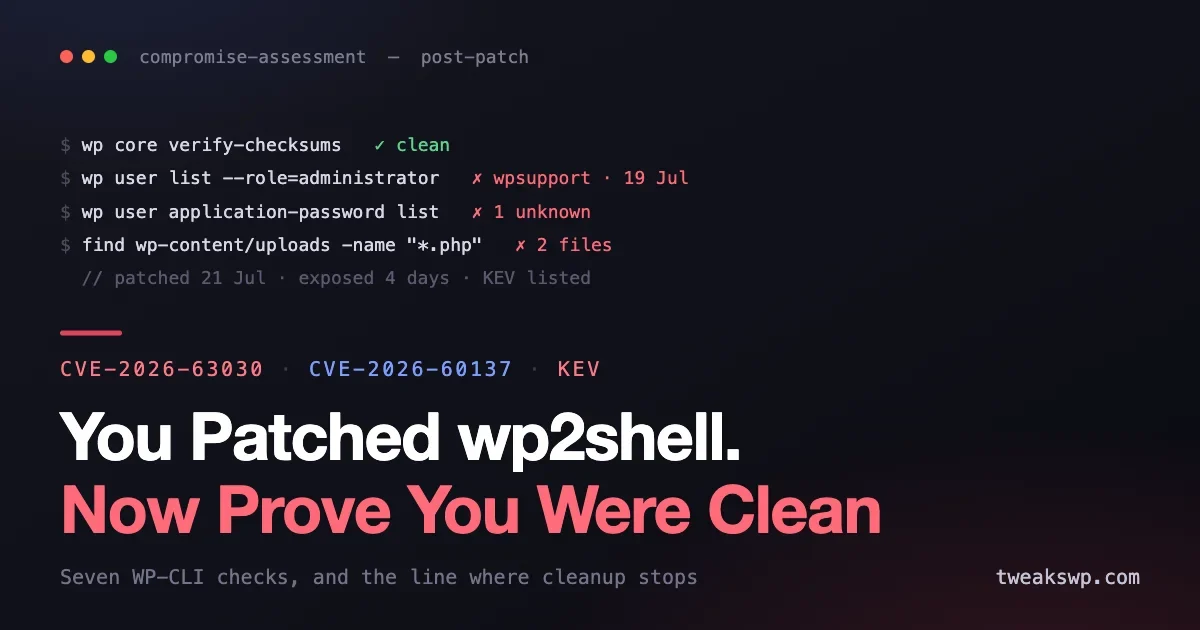
Step-by-step WordPress malware cleanup checklist covering core file verification, database injection scans, hidden admin detection, cron backdoors, and post-cleanup hardening.
Every WordPress database query that concatenates user input without $wpdb->prepare() is a ticking time bomb. This guide covers every prepare() pattern in production code.
Learn how to use AVIF images and server-level Redis caching in WordPress to reduce payload size, improve cache hit rates, and move closer to sub-second loads.
Compare the performance benefits of block-based WordPress themes versus heavy page builders in 2026, including Core Web Vitals, asset loading, DOM weight, and maintainability.