Your Guide on How to Import a Page Design into WordPress
Import a page design into WordPress by copying blocks, pattern JSON, the WordPress Importer, Site Editor export, style variations, Elementor or Figma.
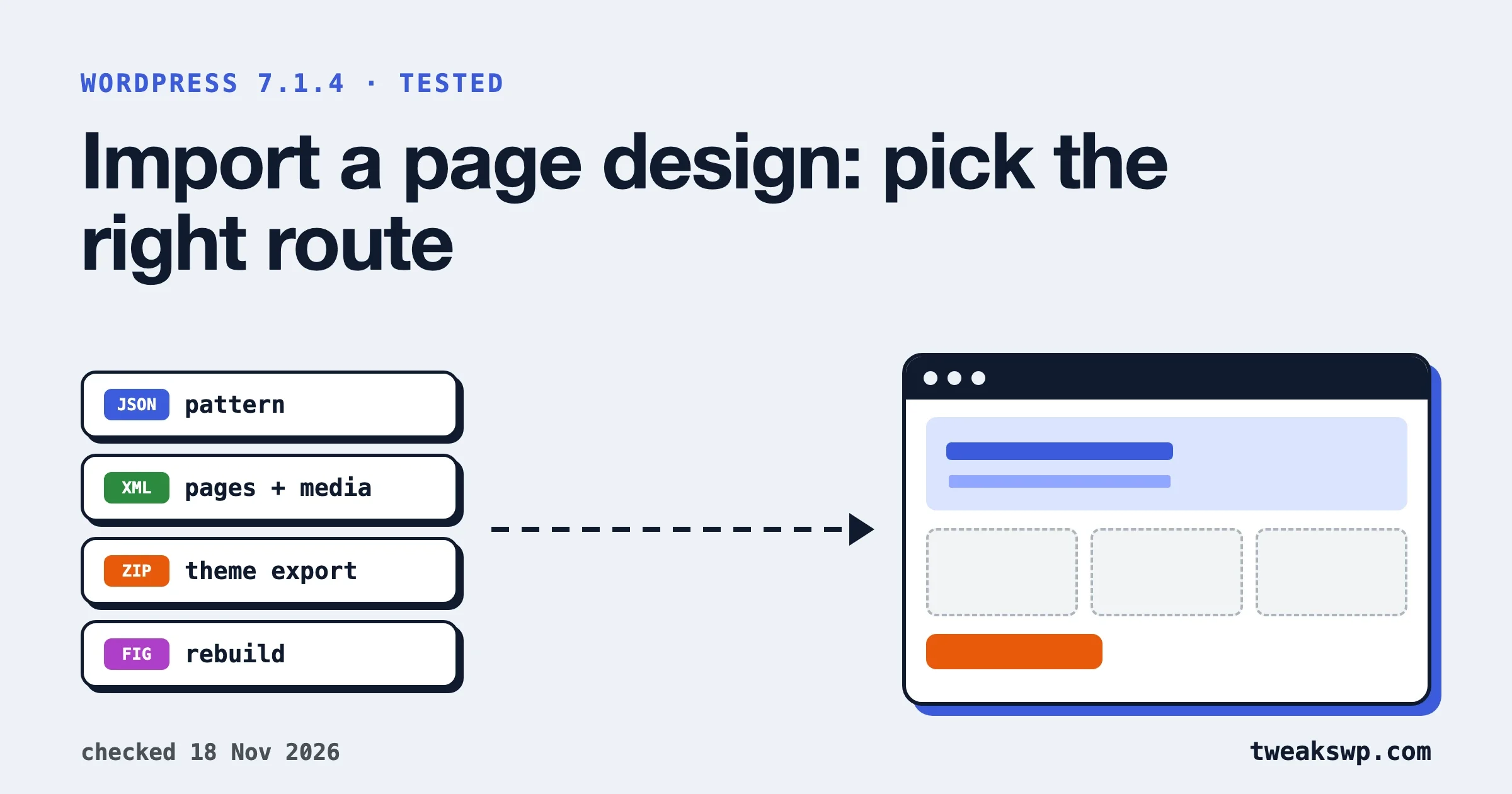
To import a page design into WordPress, match the method to what you have. A design built in the block editor on another site can be copied and pasted as blocks, or exported as a pattern JSON file and imported on the Patterns screen. A whole page with its images moves with Tools > Export and the WordPress Importer. Templates and styles from a block theme travel as a theme zip from the Site Editor, and a page builder layout imports through that builder’s own template library.
A Figma file is the odd one out. WordPress cannot open it, so it gets rebuilt in blocks or run through a converter plugin, and both take cleanup.
Our team checked every menu label, file format and command in this guide against the WordPress 7.1.4 documentation and Gutenberg source, the WordPress Importer 0.9.7 and Create Block Theme 2.10.2 plugin pages, and Elementor 4.4.1 on 18 November 2026. This page has no Search Console queries recorded yet, so the headings follow the questions people ask when a design lands on their desk.
Which import method fits the design you have?
“Import a page design” covers five different jobs. Most frustration comes from using the tool for one job on another, so start here.
What you have | Best method | What comes across | What does not |
|---|---|---|---|
A page built in the block editor on another WordPress site | Copy and paste the blocks, or export a pattern as JSON | Layout, text, block settings | Images stay on the old site until you re-upload them |
A full page, with its media, on another WordPress site | Tools > Export, then the WordPress Importer | Page content plus attached media | Media only uploaded to the library, theme styles |
Templates, headers, footers and styles from a block theme | Site Editor export (theme zip) | Templates, template parts, theme.json styles | Your pages and posts |
A colour and font scheme | A theme.json style variation | Colours, typography, spacing | Any layout |
An Elementor or other builder layout | The builder’s template import | The layout, inside that builder | Anything usable without the builder |
A Figma mockup | Rebuild with blocks, or a converter plugin | Whatever you rebuild or convert | A one-click native import |
How do you copy a page design from one WordPress site to another?
For one page, copying the blocks is the fastest route. Block markup is plain text, so the clipboard carries the whole layout, including columns, groups, spacing and colours.
- Open the source page in the editor.
- Open the editor’s options menu (the three dots at the top right) and, under Tools, choose Copy all blocks. To copy part of a page, select those blocks in List View, open the block options menu and choose Copy.
- On the destination site, create a new page, click into the empty canvas and paste.
- Save as a draft and preview it before you publish.
If pasting into the visual canvas gives odd results, switch both editors to the Code editor (Ctrl+Shift+Alt+M, or Cmd+Shift+Option+M on a Mac) and copy the raw markup across instead. That avoids the browser rewriting anything on the way.
Two things never travel with a paste. Images still point to files on the old site, and any styles that came from the old theme, such as custom colour names or fonts, fall back to whatever the new theme defines. A WordPress.org forum volunteer gives the standard advice for this: re-upload the images on the new site so the page does not depend on the old one staying online.
How do you import a block pattern from a JSON file?
If you reuse a design often, save it as a pattern and move the pattern, not the page. WordPress has built-in export and import for patterns you created yourself.
- On the source site, open the Patterns screen. Where it lives depends on your theme: Appearance > Editor > Patterns on block themes, Appearance > Design > Patterns on classic themes with editor styles, or Appearance > Patterns on other classic themes.
- Open the pattern’s actions menu and choose Export as JSON. You get a small
.jsonfile named after the pattern. - On the destination site, open the same Patterns screen, use the add new pattern button and choose Import pattern from JSON.
- Pick the file. The pattern appears in your list and in the block inserter.
Our guide to WordPress block patterns covers synced versus unsynced patterns and how to register patterns in a theme, so we will not repeat that here. What helps when an import fails is knowing what the file must look like. We read the Gutenberg import code, and it accepts only this shape:
{
  "__file": "wp_block",
  "title": "Pricing table, three columns",
  "content": "<!-- wp:columns -->...block markup...<!-- /wp:columns -->",
  "syncStatus": "unsynced"
}
Checked on 18 November 2026 against the Gutenberg trunk source. If __file is not exactly wp_block, or the title or content is missing, the import stops with “Invalid pattern JSON file”. A file that is not valid JSON at all gives “Invalid JSON file”. Leave out syncStatus and the pattern imports as synced, which means editing it later changes every page that uses it.
So a JSON file from a page builder, a theme demo or a pattern marketplace will not import here, even though it ends in .json. Only files exported from a WordPress Patterns screen, or written in this exact shape, work.
How do you use a design from the WordPress Pattern Directory?
The official WordPress Pattern Directory holds free, community-made layouts: heroes, pricing tables, team grids, footers. You do not download anything.
- Find a pattern on the directory and open it.
- Click Copy pattern.
- Paste it into any page in the block editor.
- Replace the sample images and text with your own.
Many directory patterns also appear in the block inserter under the Patterns tab, depending on your theme. Directory patterns use only core blocks, so they work on any site running a recent WordPress version. To use one as your home page layout, our walkthrough on switching a pattern into your home page shows the steps.
How do you move a whole page with its images?
Copy and paste leaves media behind. To move pages together with their images, use the built-in export and the free WordPress Importer plugin.
- On the source site, go to Tools > Export, choose Pages, narrow it by date or author if you like, and download the export file.
- On the destination site, go to Tools > Import and install the WordPress importer if it is not already there.
- Upload the export file and map authors to existing users or create new ones.
- Tick Download and import file attachments so images are copied over.
- Run the import and check each page as a draft.
The importer improved in late 2025. From WordPress Importer 0.9.5, a checkbox before the import rewrites old-site URLs inside your content, including image src values, URLs stored in block attributes such as a Cover block background, and url() values in inline styles. The announcement on Make WordPress Core notes that custom fields are not rewritten yet. The current version is 0.9.7.
One limit catches people often. The export file includes only media that is attached to the exported posts and pages. Images uploaded straight to Media > Add Media File, or added by a plugin, are not part of it, so those references keep pointing at the old site. Check every image after the import.
How do you export and import Site Editor templates?
On a block theme, your header, footer, page templates and global styles live in the Site Editor, not in the page. To move that design to another site:
- Go to Appearance > Editor.
- Open the three-dot More options menu at the top right.
- Under Tools, choose Export. WordPress downloads a zip of your theme including the templates, template parts and style changes you made in the Site Editor.
- On the destination site, go to Appearance > Themes, add a new theme, use Upload Theme and pick the zip.
- Activate it, then open the Site Editor and check every template.
Be clear about what this is. It exports a whole theme, not a single page, and it does not carry your posts or pages. If the destination site already runs the same theme, uploading the zip replaces that theme’s files, so take a backup first.
For more control, the free Create Block Theme plugin, maintained by the WordPress team, can save Site Editor changes back into theme files, create a child theme, export a theme, or save a new style variation. It also copies images used in templates into the theme’s assets folder. One caution: its plugin page lists it as tested up to WordPress 6.9.11 as of 18 November 2026, so try it on a staging copy before running it on a 7.1 production site.
How do you import a theme.json style variation?
Sometimes “the design” is really a look: a palette, a pair of fonts and spacing rules. Block themes store that in theme.json, and alternative looks are called style variations. Each one is a JSON file inside the theme’s styles folder.
{
  "$schema": "https://schemas.wp.org/trunk/theme.json",
  "version": 3,
  "title": "Harbour",
  "settings": {
    "color": {
      "palette": [
        { "slug": "base", "color": "#f4f1ea", "name": "Base" },
        { "slug": "contrast", "color": "#14213d", "name": "Contrast" },
        { "slug": "accent", "color": "#e07a2f", "name": "Accent" }
      ]
    }
  },
  "styles": {
    "color": { "background": "var(--wp--preset--color--base)", "text": "var(--wp--preset--color--contrast)" }
  }
}
Checked on 18 November 2026: version 3 is the current theme.json schema. Save the file as styles/harbour.json inside your theme (a child theme is safer than editing a theme that updates), then open Appearance > Editor > Styles. The new variation shows in the list of styles, and selecting it saves the choice to your database. The Theme Handbook page on style variations covers the full format.
Keep the colour slug values the same as the theme’s originals where you can. Blocks store the slug, not the hex value, so matching slugs means existing pages pick up the new colours instead of losing them.
How do you import an Elementor or page builder template?
Page builders keep their own template formats, and each one imports only its own files. In Elementor 4.4.1, the current version on 18 November 2026, the flow is:
- In the source site’s template library, open Templates, click the three dots next to the template and choose Export. You get a
.jsonfile. - On the destination site, open the Elementor template library, click Templates, then the upload icon.
- Pick the
.jsonfile, or a.zipholding several. - Insert the template into a page, then replace the images.
Elementor also has a command for bulk imports, which helps when a designer hands you a folder of templates:
# checked on 18 November 2026 against the Elementor developer docs
wp elementor library import path/to/template.json --returnType=ids
Whole-site kits, which bundle pages, templates and site settings, are a separate feature under Elementor’s website templates tools, and what you can import there depends on your Elementor plan. Third-party “template kits” sold on marketplaces usually come as a zip of separate JSON files plus instructions; read those before uploading the outer zip.
The lock-in point matters more than the steps. An Elementor template only renders while Elementor is active. It does not become block editor content, and Beaver Builder, Divi and the others cannot read it. If you are choosing a design for a site you will run for years, a block pattern travels further. Our guide on adding a new WordPress page with a design compares building with blocks and with a builder.
Can you import a Figma design into WordPress?
Not directly. WordPress has no Figma importer, and a Figma file is a design canvas, not web pages. You have two real options.
Rebuild it with blocks. Use Figma’s inspect panel to read exact colours, font sizes and spacing, put the colours and fonts into theme.json or the Styles panel, export images and icons from Figma, and build each section as a pattern. It is slower the first time, but the result is plain block content that any theme can show and any editor can change. For a one-off promo page, our guide to building landing pages without plugins follows this approach.
Use a converter. Tools such as UiChemy pair a Figma plugin with a WordPress plugin and turn frames into builder or block content. On 18 November 2026 its WordPress.org page showed version 5.6.1, tested with WordPress 7.1.4, about 8,000 active installs and a 100% rating from 15 reviews, which is a small sample. Converters save time on structure, but expect to fix spacing, responsive behaviour, image sizes and heading levels by hand. Ask whether the output is native blocks or content held inside the tool’s own widget, because that decides how portable the page stays.
Either way, design for the theme you will use. A mockup that ignores the theme’s content width and font scale will fight it on every page.
What if your site uses a classic theme?
Plenty of sites still run classic themes, and the rules change a little. A classic theme has no Site Editor, so headers, footers and sidebars come from the theme’s PHP templates, the Customizer and widget areas. None of that can be imported as a page design. Only the content area of a page, the part you edit in the block editor, can.
The good news is that everything in the first half of this guide still works inside that content area. Copied blocks, pattern JSON files, Pattern Directory layouts and WordPress Importer files all land in the page body the same way they would on a block theme. The Patterns screen is just in a different place, as listed earlier.
What does not work is the Site Editor export and style variations, because both depend on a block theme. If the design you were handed includes a new header, footer and global styles, you are really being asked to change themes. In that case, set up the new theme on a staging copy, rebuild the header and footer there, and move the content across with the importer, rather than trying to bolt block-theme templates onto a classic theme.
Why does an imported page look different from the original?
Almost always because the page is the same and the surroundings are not. Blocks store references such as a colour slug, a font size preset or a spacing step, and each theme decides what those references mean. The same pattern in two themes can have different fonts, a narrower content width and a different accent colour, with no error anywhere.
Compare the two themes’ theme.json files, or open Styles on both sites side by side, and align the palette slugs, font families and content width. That fixes most “it looked better on the other site” reports in minutes.
What should you check before importing any design?
- Back up, or use staging. Theme uploads and kit imports can overwrite templates and settings.
- Match the theme. A pattern built for one theme’s colour slugs and fonts looks plain on another. Compare the two
theme.jsonpalettes first. - Check the WordPress version. Content made on a newer WordPress can use block features an older site does not have, which shows up as a block recovery prompt.
- Plan the media. Decide whether images will be imported, re-uploaded or replaced, and do it before launch, not after the old site goes offline.
- Test at phone width. Imported layouts often carry fixed widths. Preview at 390 pixels before publishing.
If you are still choosing a theme to import into, our explainer on the WordPress theme download repository shows where free block themes come from and how they are reviewed.
Common mistakes people report
These come up repeatedly on the WordPress.org forums and GitHub. Sources checked on 18 November 2026.
- Images vanish after copying a page to another site. A site owner who copied an Elementor page with images added by URL found them empty on the new site (July 2024); support confirmed the URLs were tied to the original site and had to be re-added. The same applies to pasted block content.
- Expecting the export file to carry every image. One owner moved 800 media files and got about 550 (December 2023), with some images still linking to the old site. The export includes only attached media.
- Uploading the wrong kind of file to a builder. “Invalid template type” when importing into Elementor usually means the file is not an Elementor template export, as in this December 2023 thread. Kits and other builders’ files will not import there.
- A JSON import that produces a blank page. An Elementor user reported a blank page after importing a JSON file (April 2025); the advice was to check the file’s origin and the Elementor version on both sites.
- Pattern JSON import breaking after a platform update. WordPress.com users lost pattern import and export for a while in December 2024. If import fails with a script error rather than “Invalid pattern JSON file”, the editor, not your file, may be at fault.
- Images with the same filename overwriting each other on theme export. Create Block Theme keeps only one file when two template images share a name (open, November 2026). Rename images before saving a theme.
Frequently asked questions
Can I import an HTML page into WordPress?
Not as a design. Paste the HTML into a Custom HTML block and it will display, but it will not become editable blocks and its CSS may clash with the theme. Rebuilding it as blocks is the long-term fix.
Can I import a design from a ThemeForest theme demo?
Most premium themes ship a demo importer, often built on the One Click Demo Import plugin, that loads the demo pages, menus and settings. Run it on a fresh site, because it adds a lot of sample content.
Will an imported page keep my SEO settings?
Copy and paste does not carry SEO plugin data, because that lives in post meta. The export and import route carries the post meta that plugins store, as long as the same SEO plugin is active on both sites.
Is a pattern or a template better for reusing a design?
Use a pattern for a section you drop into many pages, like a call to action. Use a template when every page of one kind should share a layout, like all blog posts.
Do I need a page builder to import designs?
No. Patterns, the Pattern Directory, the Site Editor export and style variations are all built into WordPress. You need a builder only to import that builder’s own templates.
Our take
For most sites, the best “import” is a pattern. It is native, it survives theme changes, and moving it takes two clicks. Use the WordPress Importer when pages and media must move together, the Site Editor export when the design is the whole theme, and a builder’s own import only when the site already runs that builder. Whatever route you pick, check the images, preview at phone width and keep the old site online until the new one is verified.
Plugins we build and run
We maintain these ourselves, which is why we can support them on your site.
- BuddyNextThe self-hosted community engine for WordPress
- BuddyXFree community theme, Pro when you outgrow it
- ReignPremium community theme. Add pieces, build anything
- JetonomyCommunity forum and Q&A for WordPress
- EventonomyEvents and RSVPs for WordPress communities
- LearnomyCourses and learning communities on WordPress
- ListoraDirectories and listings your members can browse
- SnipShareCode sharing built for developer communities
- WB Ad ManagerAd placements that turn traffic into revenue
- WP Career BoardA job board your community actually uses
- WP Sell ServicesSell services with offers, orders, and payouts
- MediaVersePhotos, video, and media albums for members
- WB GamificationPoints, badges, and rewards that keep members active
- Product RoadmapPublic roadmaps with voting your users trust
- KanbanomyProject management with a client portal, on your own WordPress site