WordPress vs Wix
WordPress vs Wix compared on ownership, Wix plans and fees, export limits, SEO, ecommerce and user reviews, plus when Wix is the better pick.
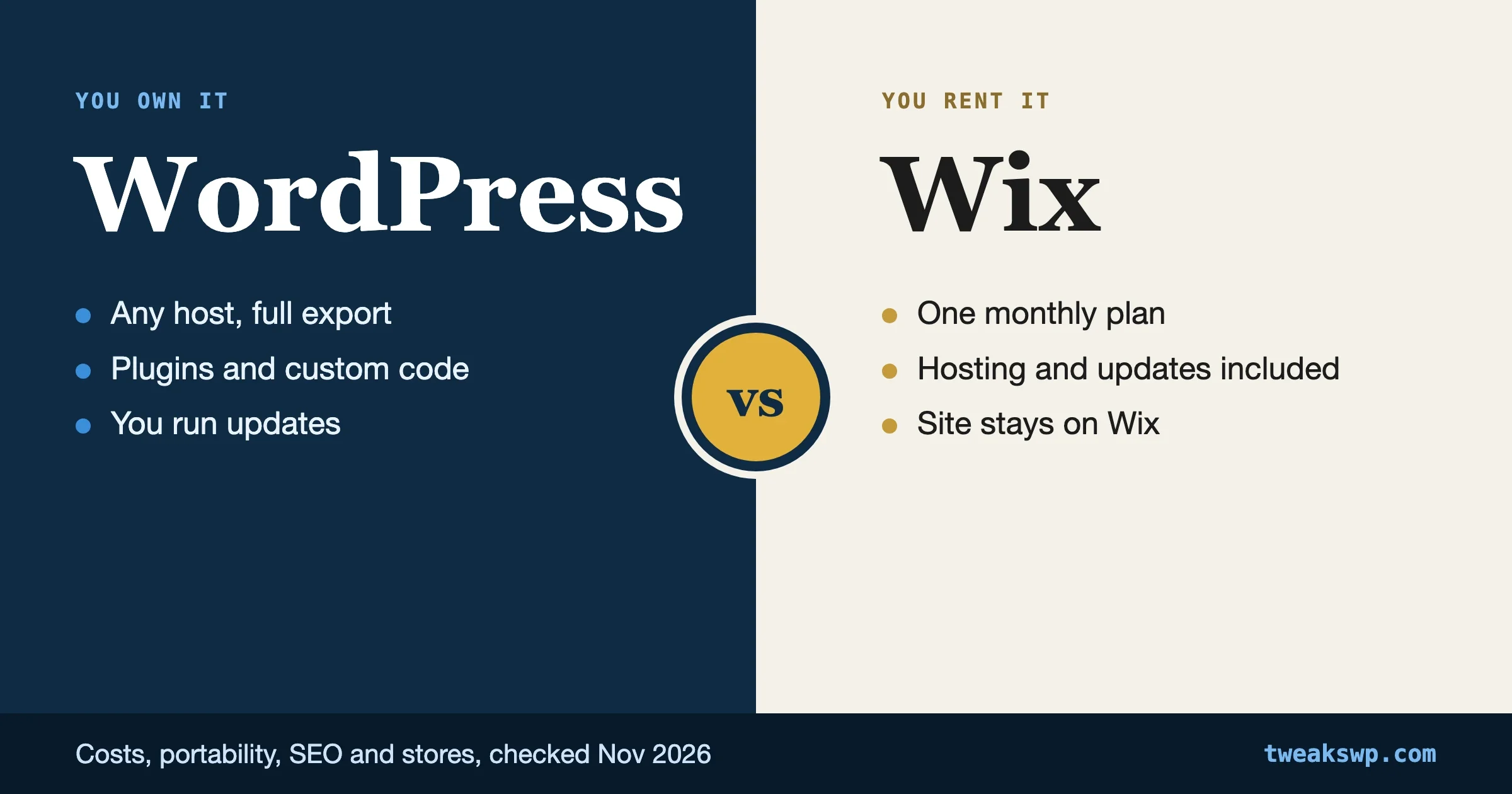
WordPress is the better choice when you want to own your site, move it to any host, and grow it with plugins and custom code. Wix is the better choice when you want one monthly bill, no hosting or updates to manage, and a site live this week. The trade is control versus convenience, and the cost of leaving Wix later is the part most people underestimate.
Our team checked every price, fee and limit below on 18 November 2026: Wix plans on wix.com in US dollars, Wix’s own Help Center articles on exporting and domains, WooCommerce data from the WordPress.org plugin API, and market share from W3Techs. Prices change and vary by region and promotion, so treat the figures as a dated snapshot and confirm on the checkout page.
When we say WordPress here, we mean the free, self-hosted software from wordpress.org. WordPress.com is a hosted service built on it, with plan-based limits closer to Wix’s model; we touch on it where it matters.
What is the real difference between WordPress and Wix?
Wix is a hosted service: you rent the builder, the hosting and the design system together, and your site only runs on Wix’s servers. WordPress is software: you install it on hosting you choose, and you can copy the whole site, files and database, to another host at any time.
Wix says this plainly in its Help Center: “Since Wix is a SaaS solution, your site must run on Wix’s servers,” and its architecture “does not support external hosting” (Wix Help Center, checked 18 Nov 2026). You can point your own domain at a Wix site, but the site itself cannot leave.
Everything else in this comparison follows from that one difference. Wix can handle security, updates and hosting for you because it controls the whole stack. WordPress can let you change anything because nothing is locked to one company.
How do WordPress and Wix compare side by side?
WordPress (self-hosted) | Wix | |
|---|---|---|
What you get | Free open-source software | Hosted website builder service |
Hosting | Your choice of host, paid separately | Included, Wix servers only |
Ownership and moving | Full export of files and database; move to any host | Site cannot be hosted elsewhere; some content exports |
Setup time | An afternoon with a host’s installer | Minutes |
Maintenance | You (or your host or developer) run updates and backups | Wix handles it |
Design | Thousands of themes, block editor, full code access | Templates and a visual editor; custom code within Wix’s limits |
Extending | Plugins from wordpress.org and commercial vendors | Wix App Market and Velo code |
Ecommerce | WooCommerce plugin (free core) and others | Built in on Core plan and above |
Support | Host support plus community forums | Wix customer care |
Share of all websites (W3Techs, 17 Nov 2026) | 38.5% | 4.2% |
How much does Wix cost compared with WordPress?
Wix sells four premium plans (Light, Core, Business and Business Elite) on a monthly fee, with the price set by your region and billing period. WordPress itself costs nothing, but you pay for hosting and a domain, plus any premium themes, plugins or developer time. For a simple site the totals can be close; the gap opens as you add features.
Wix localises its prices: the wix.com/plans page says “Prices and currency vary by location” and that “Displayed prices are for yearly subscriptions, paid in full at the time of purchase.” We could not confirm US prices from our location on 18 November 2026, so we list what each plan includes rather than a figure that may not match your checkout. Open the plans page from your own country to see your price.
Wix plan | Storage | Accept payments / ecommerce |
|---|---|---|
Light | 2 GB | No |
Core | 50 GB | Yes, Basic eCommerce |
Business | 100 GB | Yes, Standard eCommerce |
Business Elite | Unlimited | Yes, Advanced eCommerce |
A few terms in the fine print matter:
- The free plan shows Wix ads on every page, uses an address like
siteprefix.wixsite.com/siteaddress, cannot connect your own domain, and has no online payments (Wix Help Center). - The free domain is a one-year voucher on most yearly plans. Wix says it is only valid for a new domain bought from Wix, must be redeemed within 60 days, and only comes with the first Premium plan purchase. From year two you pay the domain renewal.
- If a plan lapses, Wix says the site “will revert to a free Wix URL, and any custom domain connected will be disconnected”.
- Payment processing through Wix Payments in the US is 2.9% of the transaction plus $0.30 for most cards and 3.7% plus $0.30 for American Express (Wix Payments service fees).
On the WordPress side, the costs are spread across separate suppliers, which is both the advantage and the annoyance:
WordPress cost | Required? | Notes |
|---|---|---|
WordPress software | Yes | Free (GPL licence) |
Hosting | Yes | Shared, managed or cloud; price depends on traffic and how much management you want |
Domain | Yes for a real site | From any registrar; you own the registration |
Theme | No | The default Twenty Twenty-Five and many free themes are enough for most sites |
Premium plugins | Sometimes | Forms, backups, SEO, membership or store add-ons often have paid tiers |
Maintenance time or a developer | Yes, one way or another | Updates, backups and fixes are your job or someone you pay |
The honest comparison is not “free versus a monthly plan”. It is Wix’s bundled price against your hosting bill plus the time or money spent keeping WordPress healthy. If nobody on your team will run updates, budget for a managed host or a care plan, or Wix will genuinely be cheaper for you.
Who owns your site, and can you leave Wix later?
With WordPress you own and can copy everything: Tools > Export produces an XML file of your posts, pages, comments and menus, and a full backup of files plus database moves the whole site to any host. With Wix you own your content and your domain, but the site design and structure cannot be exported, and some content types cannot be exported either.
Here is what Wix’s Help Center says about getting things out, checked on 18 November 2026:
What you want to move | Wix | WordPress |
|---|---|---|
The whole site, design included | Not possible: “your site must run on Wix’s servers” | Full copy of files and database |
Blog posts | “Currently, it is not possible to export blog posts to other platforms” (Wix Help Center) | Tools > Export (WXR file), or a full backup |
Store products | CSV export, up to 5,000 rows per file; digital products cannot be exported (Wix Help Center) | WooCommerce CSV export and import |
CMS collections | CSV export | Database and XML export |
Your domain | Transferable after 60 days via an authorization (EPP) code; the Wix site is disconnected and business email MX records must be re-added (Wix Help Center) | Registered wherever you choose; nothing tied to WordPress itself |
This is the single biggest reason we steer growing businesses toward WordPress. A five-page brochure site is easy to rebuild anywhere. A blog with three hundred posts, or a store with years of product content, is not, and on Wix that rebuild is largely manual.
Which is better for SEO, WordPress or Wix?
Both can rank well. Wix now covers the technical basics out of the box, and WordPress gives you more control through plugins and code. The content you publish and the links it earns matter far more to rankings than the platform you choose.
Wix lists these on its SEO features page: an automatically generated and editable robots.txt, sitemaps kept up to date, structured data added automatically to product pages, events and blog posts, editable meta tags, and a URL Redirect Manager for 301 redirects with CSV import of up to 500 URLs. That is a solid baseline that older comparisons, written when Wix sites were JavaScript-heavy and hard to crawl, do not reflect.
WordPress core handles clean permalinks, a basic XML sitemap at /wp-sitemap.xml (since version 5.5), and the “Discourage search engines” switch in Settings > Reading. Most sites add an SEO plugin for titles, meta descriptions, schema and redirects:
Plugins such as Rank Math or Yoast SEO add per-page titles and descriptions, schema types, redirect managers and content analysis, all editable down to the code if you need it.
Where WordPress pulls ahead is the ceiling: custom schema for any content type, full control of templates and headings, server-level caching and image handling, and the freedom to choose a faster host. Where Wix wins is the floor: a beginner on Wix is less likely to ship a site with broken basics than a beginner who never installs an SEO plugin.
Which is better for an online store?
Wix is quicker to start selling: payments and a store are built in from the Core plan up. WordPress with WooCommerce costs more effort to set up but has no platform-imposed ceiling on products, checkout customisation or extensions, and you can choose any payment provider.
On WordPress, WooCommerce is the standard store plugin. The core plugin is free on WordPress.org, has more than 7 million active installations, and was last updated on 11 November 2026 (version 11.3.0), per the WordPress.org plugin API checked on 18 November 2026.
WooCommerce on WordPress | Wix eCommerce | |
|---|---|---|
Starting cost | Free plugin; you pay hosting | Core plan or higher, priced by region |
Card fees (US) | WooPayments: 2.90% + $0.30 for US cards; or Stripe, PayPal and others | Wix Payments: 2.9% + $0.30 (Amex 3.7% + $0.30) |
Product export | Full CSV export and import | CSV, 5,000 rows per file; no digital products |
Customising checkout | Full code access, block-based checkout | Within Wix’s settings and apps |
Who maintains it | You or your host/developer | Wix |
WooPayments fees are from WooCommerce’s fee documentation; WooPayments adds an international fee for cards issued outside the US, so check both full fee tables if you sell abroad. For a deeper look at what a WordPress store involves, see our guide on whether WordPress can do ecommerce.
Which is easier to use and maintain?
Wix is easier on day one and stays easier, because there is nothing to update, patch or back up. WordPress has a learning curve and ongoing upkeep, but the block editor and patterns have narrowed the design gap considerably since 2022.
On Wix you never see a server, a plugin update or a PHP version. Wix runs hosting, SSL, security and platform updates. You trade that for working inside Wix’s editor and its rules.
On WordPress, the day-to-day work is writing posts and pages in the block editor, adding images, and keeping themes, plugins and core updated with a backup in hand. Minor WordPress security releases install automatically by default. Our beginner guide on how to use WordPress walks through that routine menu by menu, and how to set up your first WordPress site covers the one-time setup.
If you hate the idea of maintenance, be honest about it. An unmaintained WordPress site, with plugins left out of date for a year, is a real security risk. An unmaintained Wix site is mostly just a stale site.
Can you add custom code and features?
Yes on both, with very different limits. WordPress lets you edit or add any PHP, JavaScript or CSS, build custom plugins, and run whatever your host allows. Wix allows custom code through Velo and custom elements, inside Wix’s platform and plan rules.
Wix’s developer documentation says custom elements “let you add custom HTML, CSS, and JavaScript to extend your site’s functionality beyond the built-in editor,” and that to use them on a live site “you must have a Premium Plan, connect a custom domain, and remove ads” (Velo docs). That is enough for many integrations, but you cannot change how Wix itself works, install server software, or run your own database.
On WordPress the ceiling is your hosting and your developer. Membership sites, learning platforms, directories, communities and complex B2B stores are all built on WordPress with plugins and custom code. Our post on WordPress as a development platform covers where that flexibility pays off and where it is overkill.
When is Wix genuinely the better choice?
More often than WordPress-focused sites like to admit. If the points below describe you, Wix is the sensible pick, and there is no shame in it.
- Nobody will maintain the site. A sole trader with no time for updates is better served by a platform that patches itself than by a WordPress install left untouched for a year.
- The site is small and stable. A five to ten page site for a salon, a tradesperson or a portfolio rarely needs plugins, custom code or a growing archive.
- You need it live this week. Pick a template, swap the text and photos, connect a domain on a paid plan, and you are done, with hosting and SSL included.
- You want one bill and one support desk. On WordPress, a problem can sit between the host, a theme developer and a plugin developer. On Wix there is one company to contact, even if reviewers say reaching it can be slow.
- The site is short-lived. An event, a campaign or a seasonal pop-up shop that will be retired in a year does not need portability.
Wix becomes the wrong choice when the site turns into an asset: hundreds of posts that bring search traffic, a store you plan to grow, or features that need custom development. That is the point to move, and moving earlier is cheaper than moving later.
What users say, and our suggestion
We looked at recent public reviews for Wix and at WordPress.org data for WooCommerce, the closest like-for-like product on the WordPress side (core WordPress has no single review page). Checked on 18 November 2026.
Wix
- Rating: TrustScore 3.4 out of 5 from 29,465 reviews on Trustpilot, with the newest reviews dated October and November 2026.
- Praised: the editor is easy and self-explanatory for people with no technical background; the free starting plan and the built-in AI tools help small businesses get online fast; several reviewers say the platform has improved over time.
- Complained about: automatic yearly renewals that reviewers say they could not reverse or get refunded; support that is hard to reach or bot-led for billing and account problems; domain transfer and account restrictions; and, in a few recent reviews, unreliable saving when editing products. One November 2026 reviewer wrote that there is “no way to save your work safely” when uploading new products.
- G2 and Capterra blocked our automated checks, so we have not quoted their scores here rather than repeat figures we could not confirm on the day.
WordPress with WooCommerce
- Rating: 4.5 out of 5 (90% in the API) from 4,832 ratings, more than 7 million active installs, and 87 of the 125 support threads in the last two months marked resolved, per the WordPress.org plugin page and API.
- Praised: how quickly a shop can be built, flexibility and customisation, and that the core is free. Recent reviews on the WooCommerce reviews page are mostly short positive notes, such as “The best pliggin for easy shop building” (typo in the original).
- Complained about: updates that broke sites or pages, with several reviews in 2026 pointing at specific releases; shipping and billing edge cases that needed support or extra extensions.
The pattern is consistent with the platform difference. Wix complaints centre on billing, support access and lock-in, because Wix controls the account. WordPress complaints centre on updates and compatibility, because you run the software and each plugin is a separate moving part.
Our suggestion
- Choose Wix for a small brochure site, portfolio, event page or local business site you want live quickly, where nobody will maintain software, and where you are comfortable rebuilding if you outgrow it. Turn off auto-renew reminders on your calendar and read the renewal terms before you pay.
- Choose WordPress if content is your long-term asset (a blog, a resource library, a growing store), if you need custom features, memberships or integrations, or if owning and moving your site matters to you. Budget for hosting and for maintenance, either your time or a paid plan.
- Consider WordPress.com if you want WordPress’s portability with hosting and updates handled for you, and check which plan allows the plugins you need.
How do you move from Wix to WordPress?
There is no one-click migration, because Wix cannot export the site itself. You rebuild the design in WordPress, bring content across in pieces, and redirect the old URLs. Plan it like a small project rather than an evening task.
- Inventory every URL on the Wix site (the sitemap at
yoursite.com/sitemap.xmllists them) and note which pages get traffic. - Set up WordPress on new hosting or a staging address, and choose a theme close to the design you want.
- Move blog posts. Because Wix cannot export them, copy them manually or pull them from the blog’s RSS feed with an importer. Check that every post arrived, since a feed may not contain the full archive.
- Move products by exporting the CSV from Wix Stores and importing it into WooCommerce (Products > Import), then re-add digital products by hand.
- Rebuild pages with blocks and patterns; re-upload images to the Media Library.
- Map redirects from every old Wix URL to its new WordPress URL with 301 redirects, so search rankings and shared links carry over.
- Point the domain at the new host (or transfer it away from Wix once it is past the 60-day lock), re-add email MX records, then test forms, checkout and redirects.
Keep the Wix plan active until the new site is live and checked. Cancelling first disconnects the domain and takes the old content offline while you still need it for reference.
Frequently asked questions
Is Wix cheaper than WordPress?
For a small site with no one to maintain it, often yes, once you count maintenance time. For a site that needs specific features, WordPress is usually cheaper over a few years, because you are not paying a higher plan tier for each capability and you can pick your hosting.
Can you switch from Wix to WordPress without losing SEO?
Mostly, if you keep the same domain, rebuild the important pages with the same content, and set up 301 redirects for every changed URL. Expect some ranking movement for a few weeks while search engines recrawl.
Is Wix good for SEO in 2026?
Yes for the basics. Editable robots.txt, automatic sitemaps, structured data, meta tags and a 301 redirect manager are built in. WordPress offers more control at the advanced end.
Can you install WordPress plugins on Wix?
No. Wix uses its own App Market and Velo code. WordPress plugins only run on WordPress. On WordPress.com, plugin installation depends on your plan; our post on installing other software on WordPress.com explains the limits.
Does Wix own my content?
No, your content is yours, but it lives on Wix’s platform and only some of it can be exported in a usable format. Blog posts in particular cannot be exported to other platforms, according to Wix’s Help Center.
Which is more popular?
WordPress, by a wide margin. W3Techs reported on 17 November 2026 that WordPress runs 38.5% of all websites and Wix 4.2%.
Pick Wix for speed and zero maintenance on a site you could rebuild without pain. Pick WordPress when the site is an asset you plan to grow and keep for years. If you cannot decide, ask one question: what would it cost us to move this site in three years? On WordPress the answer is a migration; on Wix it is a rebuild.
Plugins we build and run
We maintain these ourselves, which is why we can support them on your site.
- BuddyNextThe self-hosted community engine for WordPress
- BuddyXFree community theme, Pro when you outgrow it
- ReignPremium community theme. Add pieces, build anything
- JetonomyCommunity forum and Q&A for WordPress
- EventonomyEvents and RSVPs for WordPress communities
- LearnomyCourses and learning communities on WordPress
- ListoraDirectories and listings your members can browse
- SnipShareCode sharing built for developer communities
- WB Ad ManagerAd placements that turn traffic into revenue
- WP Career BoardA job board your community actually uses
- WP Sell ServicesSell services with offers, orders, and payouts
- MediaVersePhotos, video, and media albums for members
- WB GamificationPoints, badges, and rewards that keep members active
- Product RoadmapPublic roadmaps with voting your users trust














Related Posts
LiteSpeed Cache Vulnerability CVE-2026-93389: Check Your Version and What Was Exposed
Freemius SDK Stored XSS: How to Find Every Bundled Copy on a Client Site (Anything Under 2.13.5)