Best Software to Build a SaaS Customer Community
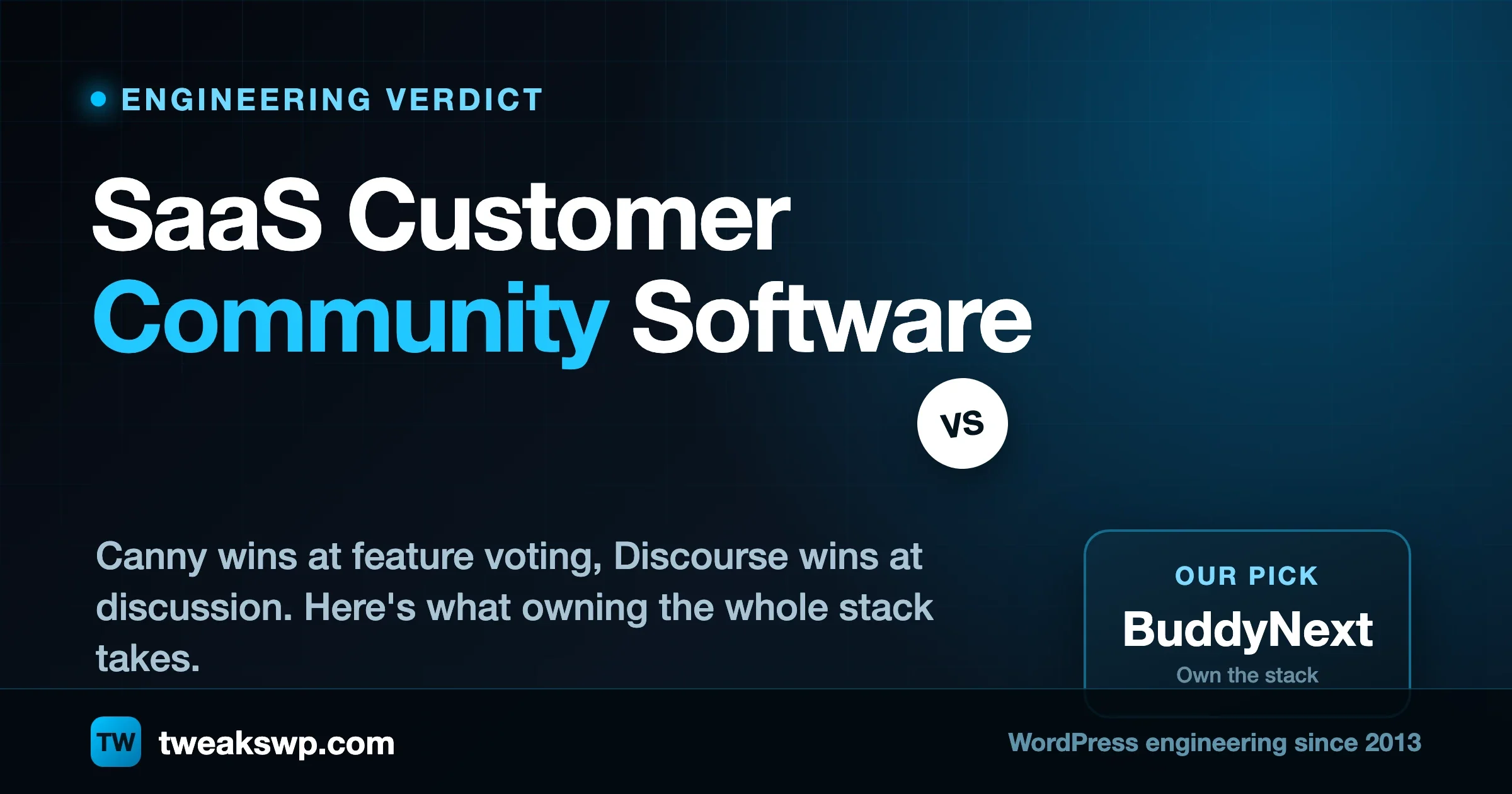
Canny wins at feature voting, Discourse wins at deep discussion. What a SaaS customer community actually needs across feedback, support, and a public roadmap, and when a self-hosted WordPress build with BuddyNext makes more sense than renting the stack.
A SaaS customer community has one job that a help desk cannot do: let customers see each other, upvote the same feature request, and realize the problem they are stuck on is not unique to them. The support ticket model hides that signal. A real community surfaces it, which is why most growing SaaS companies eventually build a space for exactly this, even after they already have a help center and a support inbox.
Short version: Canny and similar dedicated feedback tools are the fastest way to get structured feature voting and a public roadmap live, and they do that one job well. Discourse and Vanilla Forums are the stronger choice once customers need real discussion threads, not just upvotes, around troubleshooting and best practices. BuddyNext is what we would build if your SaaS product’s marketing site already runs on WordPress and you want the customer community, the feature request board, and the support forum living on the same domain and the same user accounts you already manage, instead of a separate tool with its own login.
What a SaaS customer community actually needs to do
Every SaaS community serving existing customers is answering some combination of four questions: what feature should we build next, how do other customers solve this specific problem, is this a known bug or something unique to my setup, and where can I see what has already shipped. Those four needs map to four different interface patterns: a voting board for feature requests, a discussion forum for troubleshooting, a changelog or roadmap view, and search that spans all of it so a customer with a question does not have to guess which tool holds the answer.
Most platforms in this space specialize in one or two of these and treat the rest as secondary. A feedback-and-roadmap tool like Canny nails the voting and changelog pattern and has no real discussion forum. A forum platform like Discourse nails the discussion pattern and has no native roadmap view. This is the single biggest decision point for a SaaS company choosing a platform: do you need one tool that does all four adequately, or two specialized tools that each do their piece well and need to be linked together.
The real platform landscape for SaaS customer communities
Canny built its entire product around feature request voting and public roadmaps, and it remains the fastest way to get a clean, structured board live where customers can submit ideas, upvote existing ones, and see status move from under review to planned to shipped. It has essentially no discussion or forum functionality, and most SaaS teams running it treat it purely as a feedback intake and roadmap communication tool, with actual support and discussion happening somewhere else entirely.
Discourse is the open-source standard for structured discussion forums, and a meaningful share of developer-facing SaaS products run their customer community on it specifically because its threading, tagging, and search hold up at real scale with thousands of topics. It has a steeper admin learning curve than a hosted feedback tool and no native feature-voting board, though its trust-level and badge system does a genuinely good job of surfacing your most knowledgeable customers as unofficial moderators over time.
Vanilla Forums positions itself specifically at enterprise and mid-market SaaS customer communities, with built-in integrations aimed at support ticket deflection and knowledge base tie-ins. It is a capable, mature platform, and its pricing reflects an enterprise sales model rather than a self-serve monthly plan, which puts it out of reach for many smaller SaaS teams evaluating this category.
Circle has picked up real traction as a general-purpose customer community platform for SaaS companies that want community, a lightweight course area for onboarding content, and events in one place, without needing the specialized voting mechanics of Canny or the forum depth of Discourse. For a SaaS product where community is more about belonging and peer learning than structured feature requests, Circle’s space-based organization fits that need reasonably well.
BuddyNext is the self-hosted answer for a SaaS company whose marketing site and documentation already run on WordPress. It brings activity feeds, discussion groups organized by topic or product area, and member profiles, running on infrastructure you already control, with the same user accounts as the rest of your WordPress site if you choose to connect them. It does not ship a purpose-built feature-voting board the way Canny does, so a SaaS team choosing BuddyNext for the community layer typically pairs it with a lightweight custom post type or a feedback plugin for the voting piece specifically, while BuddyNext handles discussion, troubleshooting threads, and the sense of belonging a pure voting tool cannot provide on its own.
What building and running this actually takes
A hosted platform like Canny, Discourse’s hosted tier, or Circle means a recurring subscription, usually scaled by monthly active users or team seats, and it means your customer data and discussion history live on their infrastructure under their terms. Setup is fast, typically live within a day, and the vendor handles uptime, security patching, and feature development on their own release cycle, which you have no control over.
Self-hosting Discourse or running BuddyNext on WordPress means real infrastructure responsibility: choosing hosting that can handle your expected active user count, keeping the platform and its plugins updated, and owning your own security posture, including how customer accounts are authenticated and how sensitive support discussions are access-controlled if some content should only be visible to paying customers versus trial users. In exchange, you own the data outright, you can customize the structure to match your product’s actual feature areas instead of working inside someone else’s category system, and you avoid a per-seat or per-MAU pricing model that grows against you exactly as your customer base grows.
For a SaaS company specifically, the authentication question deserves its own attention: does your community need single sign-on with your actual product so customers do not create a second account, and does the platform support gating certain spaces to only customers on specific plan tiers. Hosted platforms vary widely in how well they support SSO and plan-based gating out of the box; a self-hosted WordPress build can implement either against your own user system directly, at the cost of the engineering time to wire it up.
Pricing structures as a SaaS customer community scales
Canny, Discourse’s hosted tier, and Circle generally price by monthly active users, team seats, or a tiered feature structure, which means the platform bill grows as your customer base and community engagement grow. For a SaaS company whose whole business model depends on growing its customer count, a community tool with pricing tied directly to that same growth curve can become a meaningfully larger line item than expected once the product succeeds.
Vanilla Forums’ enterprise pricing is typically negotiated and substantial, which puts a floor under the category that only makes sense once a SaaS company has grown past the point where a self-serve tool’s limitations become the real constraint. Self-hosted Discourse or BuddyNext on WordPress decouples the platform cost from active user count entirely; your cost is hosting capacity for your actual traffic, not a per-seat or per-MAU fee, which tends to favor the self-hosted path specifically once a SaaS product has real growth momentum behind it.
Choosing the stack behind your SaaS customer community
If your primary need is structured feature request voting and a public roadmap, and discussion is secondary, Canny alone is the fastest and most purpose-built answer, and pairing it with your existing support tool for everything else is a completely reasonable long-term setup. If deep discussion and troubleshooting at real scale is the core need, Discourse’s maturity and search quality are hard to match, hosted or self-hosted.
If your SaaS product’s marketing site and docs already run on WordPress, and you want the customer community living on the same domain, the same hosting relationship, and ideally the same user accounts, BuddyNext paired with a lightweight feature-request addition is the platform built for that specific combination, at the cost of not having Canny’s dedicated voting polish out of the box. This is generally the right call once a SaaS team has already validated that community matters to their retention and wants to own that relationship for the long run, rather than renting it from a vendor whose pricing and roadmap decisions you cannot influence.
Who should actually pick which platform
An early-stage SaaS product with a small but vocal user base that mainly needs structured feedback intake should start with Canny or a similarly lightweight voting tool. The setup is fast, the pricing at low MAU is manageable, and a small team can commit to the review cadence that makes a voting board credible without it becoming a second job.
A developer-facing SaaS product, an API, a dev tool, infrastructure software, where customers genuinely want to help each other troubleshoot and share implementation patterns, is the clearest fit for Discourse. Its threading and search depth reward exactly the kind of long, technical discussion that a developer audience tends to produce, and its trust-level system naturally promotes your most helpful power users into informal moderators over time.
A mid-market or enterprise SaaS company with a dedicated customer success or community team, and budget to match, should evaluate Vanilla Forums specifically for its support-deflection integrations, which are built around exactly that organizational structure and are harder to replicate with a lighter tool.
A SaaS company that wants a single, approachable space combining light onboarding content, events, and discussion, without needing deep forum mechanics or dedicated voting, fits Circle’s general-purpose model well, particularly for products where community doubles as a retention and engagement driver rather than a pure support channel.
A SaaS company whose entire web presence, marketing, documentation, and blog already runs on WordPress, and that wants its customer community to live on that same domain under the same technical stack it already maintains, is the target case for BuddyNext. This case is common enough that it is worth checking seriously before assuming a separate SaaS-specific tool is the only option, particularly for SaaS companies that started as a WordPress plugin or theme business and are extending into a broader product.
Data ownership and the vendor-dependency question
A SaaS company’s customer community accumulates real institutional knowledge over time: solved troubleshooting threads, the history of which feature requests got built and why, the informal documentation that forms in community discussion that never makes it into the official docs. On a hosted platform, that knowledge lives inside a vendor’s database under their export policies, and a pricing change, an acquisition, or a sunset decision by that vendor can put years of accumulated community value at risk with little recourse beyond whatever data export the vendor chooses to support.
Self-hosting on WordPress with BuddyNext does not remove the operational work, it relocates ownership of that history entirely to the SaaS company itself. The tradeoff is real engineering and maintenance responsibility in exchange for a guarantee that the community’s accumulated knowledge, member relationships, and discussion history cannot be taken away or re-priced by a third party. For a SaaS business planning to operate for the long term, this calculus tends to shift toward ownership as the community’s value compounds year over year.
Mistakes we see SaaS teams make when they build this themselves
The most common mistake is launching a feature request board before the company has decided whether it will actually close the loop by shipping voted features and marking them done. A voting board with hundreds of untouched requests reads as evidence the company does not listen, which is worse than not having a public board at all. Commit to a review cadence before launch, not after.
The second mistake is picking a platform based on its voting or forum features alone without checking authentication fit. A SaaS company that forces customers to create a brand-new account just to post in the community introduces real friction that depresses participation, regardless of how good the platform’s core features are. Verify SSO or account-linking support before committing to a platform, not after rollout.
The third mistake is treating the community as a support deflection tool exclusively, without giving customers a reason to return when they do not have an active problem. Communities that only exist for troubleshooting go quiet between incidents. The platforms that sustain real engagement add some combination of changelog visibility, early access programs, and genuine peer discussion, not just a ticket-adjacent Q&A board.
A related version of this mistake is launching the community with no seed content at all, expecting customers to fill an empty forum on day one. Every successful SaaS community launch we have seen starts with the internal team seeding real threads, answering early questions visibly and quickly, and pre-populating a handful of genuinely useful discussions before the first external customer ever sees the space. An empty community reads as abandoned even on day one; a community with ten real threads reads as active, and that first impression shapes whether early members bother posting at all.
The fourth mistake is underestimating moderation workload. Even a well-behaved SaaS customer base needs someone reviewing new posts, merging duplicate feature requests, and keeping discussion on topic. Budget real staff time for this before launch, on any platform, rather than assuming the community will self-moderate, and plan for that workload to grow roughly in proportion to active member count rather than staying fixed.
Quick comparison: Canny vs Discourse vs Vanilla Forums vs Circle vs BuddyNext for a SaaS customer community
- Canny: purpose-built feature voting and public roadmap, little to no forum functionality, priced by team seats or MAU.
- Discourse: mature, scalable discussion forum, no native voting board, strong search and trust-level moderation, hosted or self-hosted.
- Vanilla Forums: enterprise-focused support community platform, strong support deflection integrations, negotiated pricing floor.
- Circle: general community platform with light course and events support, priced by member tier, not specialized for feature voting.
- BuddyNext: self-hosted WordPress community layer on the same domain as your product site, pair with a feedback plugin for voting, hosting cost only, no per-MAU fee.
If platform ownership and WordPress-native integration matter to your decision, it is also worth reading our comparisons of the best WordPress community plugins and our Circle alternatives breakdown before you commit.
FAQ
What is the best platform for a SaaS feature request community?
For dedicated feature voting with a public roadmap and the fastest path to launch, Canny remains the purpose-built default. If you need that alongside real discussion threads and troubleshooting on the same platform, you are better served by a general community tool like Discourse, Circle, or BuddyNext paired with a feedback module, since no single platform does structured voting and deep discussion equally well.
Can I connect my SaaS product’s login to a community platform?
Most hosted platforms, including Discourse and Circle, support SSO integration, though the depth varies by plan tier. A self-hosted build on WordPress with BuddyNext can connect directly to your existing user system since you control both sides of the integration, which tends to be more flexible but requires engineering time to implement.
How do I gate community content by customer plan tier?
Hosted platforms vary in native support for plan-based gating; some require workarounds through groups or categories. A self-hosted WordPress community with BuddyNext can implement plan-based access directly against your billing or membership system, since you control the underlying logic rather than working within a vendor’s permission model.
Should a SaaS company use its community to replace support tickets?
No. A community supplements support by surfacing shared problems and peer solutions; it should not become the only channel for account-specific or urgent issues, which still need a private, guaranteed-response support path.
What does Canny cost compared to a self-hosted WordPress community?
Canny prices by team seats and tracked users, which grows as your customer base and internal team grow. A WordPress setup with BuddyNext has upfront setup cost and ongoing hosting fees that scale with traffic rather than user count, which tends to be more predictable and often cheaper once a SaaS company has a meaningful customer base.
How much moderation does a SaaS customer community need?
Plan for regular, ideally daily, review of new posts and feature requests, duplicate merging, and spam control, regardless of platform. A community with no active moderation presence tends to either go quiet or accumulate unanswered requests, both of which undermine the reason the community exists.
Is BuddyNext a good fit if I do not already run WordPress?
Probably not as a first choice. BuddyNext’s advantage is tightest when your product’s marketing site, documentation, or support content already runs on WordPress, since the community then shares infrastructure, accounts, and domain with what you already operate. A SaaS company with no existing WordPress footprint usually finds a hosted platform faster to evaluate, even if the long-term ownership tradeoff still favors self-hosting once the community proves its value.
Can a SaaS community run feature voting and discussion forums side by side on the same domain?
Yes, and this is exactly the setup most mature SaaS communities end up with once they outgrow a single-tool approach. A common pattern is a dedicated feedback tool or a lightweight custom voting module for feature requests, linked from a discussion forum or BuddyNext community handling troubleshooting and peer discussion, both reachable from the same navigation so customers do not have to guess which tool answers which kind of question. The integration work to link the two cleanly, with consistent navigation and ideally shared login, matters more to the customer experience than which specific tools sit behind that navigation.
Should customer community access be tied to an active subscription, or open to anyone who’s ever paid?
Most SaaS companies gate full community access to active subscribers only, since the community’s value (feature requests reaching the roadmap, direct support access) is a retention lever, not a one-time perk. A public read-only tier for prospects evaluating the product, with posting and voting reserved for paying customers, is a common middle ground that still lets the community double as a pre-sales trust signal.
How do we stop the community from becoming a dumping ground for support tickets instead of genuine discussion?
Separate the two explicitly rather than hoping members self-sort: a dedicated support space with its own SLA expectations, and a distinct discussion or feature-request space with different moderation rules. Routing support-shaped posts to the support space quickly (a pinned note or a bot reply pointing there) keeps the discussion spaces from drowning in ticket-shaped noise.
Plugins we build and run
We maintain these ourselves, which is why we can support them on your site.
- BuddyNextThe self-hosted community engine for WordPress
- BuddyXFree community theme, Pro when you outgrow it
- ReignPremium community theme. Add pieces, build anything
- JetonomyCommunity forum and Q&A for WordPress
- EventonomyEvents and RSVPs for WordPress communities
- LearnomyCourses and learning communities on WordPress
- ListoraDirectories and listings your members can browse
- SnipShareCode sharing built for developer communities
- WB Ad ManagerAd placements that turn traffic into revenue
- WP Career BoardA job board your community actually uses
- WP Sell ServicesSell services with offers, orders, and payouts
- MediaVersePhotos, video, and media albums for members
- WB GamificationPoints, badges, and rewards that keep members active
- Product RoadmapPublic roadmaps with voting your users trust