Best Software to Launch an n8n Automation Community
n8n already has a free official forum and Discord. The real platform comparison, the version-aware workflow library build, and what it takes to differentiate a paid n8n community.
An n8n-focused community sits in an unusual spot: the tool itself already has an official forum and a large Discord server, both free, both already full of the exact people you’d want in a community built around it. Launching a separate n8n automation community only makes sense if it offers something those official channels genuinely don’t, usually a paid tier with structured courses, a curated and searchable workflow library, or a specific angle (a particular industry, a particular use case) the broad official community doesn’t serve well. Get that differentiation wrong and you’re building a worse version of something that already exists for free.
This piece covers both halves honestly: the real platform landscape for an n8n community today, since no comparison for this specific audience exists on our sister site yet, and what it actually takes to build, host, and maintain a self-hosted version if that’s the right call for your specific angle.
Worth saying up front, because it shapes every recommendation below: the bar for a separate n8n community to justify its own existence is higher than for most other niches in this series, precisely because the free official alternative is unusually good. A generic Circle or Skool community wrapped around a tool with a weak official support channel has an easy case for existing. One wrapped around n8n specifically needs a sharper answer to “why not just use the free Discord,” and the platform choice should follow from that answer, not precede it.
The real options for an n8n community right now
n8n’s own official community forum and Discord are the default first stop for anyone with an n8n problem, and for good reason: n8n’s own team is active there, the content is specific to the current version, and it’s free. The weakness is exactly what you’d expect from an official support channel: it’s organized around getting help, not around building a lasting, curated library of best-practice workflows, and anything beyond direct technical support (courses, paid consulting, an industry-specific angle) has no real home there.
Skool dominates the paid side of this space right now. The AI Automation Society and similar n8n-adjacent Skool communities have built large, highly engaged paid memberships around n8n and broader automation content, using Skool’s built-in gamification and course structure. If your plan is “sell a paid n8n course with a community wrapped around it,” Skool is a legitimate, proven starting point, and the honest comparison has to acknowledge that rather than default to recommending self-hosting regardless of fit.
A self-hosted platform (BuddyNext) makes sense once you want to own the member relationship and the content library long-term rather than renting it from a platform that takes a seat-based or revenue-based cut indefinitely. It’s the right call for a community with real staying power and growth ambition, not for validating whether an n8n-focused paid community has an audience at all.
Circle and Discourse round out the realistic shortlist: Circle for a lighter-weight paid community without wanting to run WordPress yourself, Discourse specifically if the primary value is long-form technical discussion and you don’t need course or payment infrastructure built in. Both are reasonable for a mid-size n8n community that doesn’t yet need the full ownership and customization BuddyNext offers, and both remain reasonable landing spots indefinitely for a team that’s decided the self-hosted engineering investment isn’t worth it for their specific size and ambition, or that simply prefers to keep operations lighter than running a WordPress install themselves.
Quick read: validate with Skool or the official channels first if you’re untested. Move to BuddyNext once you have a proven paid audience and want to own the infrastructure, the course content, and the workflow library rather than rent it.
What building this on BuddyNext actually involves
A workflow library that’s actually organized, not just a dump of JSON files. The value of a curated n8n library over the chaos of a Discord channel is structure: workflows tagged by use case, by complexity, by which n8n version they were last verified against. That tagging needs to live in the content model from the start, not get bolted on once the library has grown unmanageably.
Code-aware rendering for workflow JSON and expressions. Same requirement as every automation-adjacent community in this series: fenced code blocks that preserve JSON structure, a monospace font that doesn’t mangle n8n’s expression syntax, and ideally a way to preview a workflow’s node structure without requiring a full n8n import just to understand what’s being shared.
Version-awareness baked into the content itself. n8n ships updates often enough that a workflow built eight months ago may not import cleanly today. A “last verified on n8n X.Y” field on each shared workflow, surfaced prominently, is a small build decision that saves members from the single most common frustration in automation communities: trying a shared workflow that silently fails because of a version mismatch nobody flagged.
These three requirements share a common thread worth naming explicitly: they’re all about trust in the archive, not about any single feature in isolation. A member paying for access to a curated n8n workflow library is paying for the promise that what they find there will actually work, will actually be current, and will actually be organized well enough to find in the first place. Every build decision in this section exists to keep that promise true as the library grows past the size where any one person can personally vouch for every entry.
Picking the differentiation angle before picking the platform
The platform decision above only makes sense once you’ve named the specific angle clearly, and this is worth more scrutiny than most teams give it before building. “An n8n community” is not a differentiated product; “a workflow library curated for e-commerce automation, verified against current n8n versions, with weekly office hours” is. The second version has an obvious reason to exist alongside the free official channels; the first doesn’t, and will struggle to justify a price or sustained engagement once the novelty wears off.
Common, genuinely differentiated angles worth considering: an industry vertical (e-commerce, real estate, agency operations) where the shared workflows need domain context the general n8n community won’t provide; a skill-level focus (complete beginners who find the official forum intimidating, or advanced users doing custom node development); or a service wrapper (community access bundled with implementation support or office hours, which Skool-style communities do well but a self-hosted build can do with more flexibility once there’s proven demand). Pick one clearly before the platform conversation, not after, since the platform that fits a vertical-focused workflow library and the platform that fits a beginner-friendly office-hours program aren’t necessarily the same choice.
A concrete example: a version-compatibility flag that actually gets maintained
The hard part of version-awareness isn’t the field, it’s keeping it current. A static “verified on 1.44” tag that never updates is worse than no tag at all, because it creates false confidence. The practical build: a lightweight community-flagging mechanism where any member can mark a workflow as “no longer imports cleanly” on a specific version, which bumps it into a review queue rather than silently sitting there with a stale green checkmark. The original poster (or a moderator, if the poster’s gone inactive) gets notified and can update the workflow or the stated compatible version.
This is a genuinely small addition to Jetonomy’s existing Q&A content model, a status field plus a simple flagging action, and it’s the kind of detail that makes the difference between a workflow library people trust and one they learn to distrust after the third broken import. Building trust in the archive is the entire value proposition of paying for this over the free official Discord.
A closer look at why Skool wins the paid-n8n-community space right now
It’s worth being specific about what Skool actually does well here, since the honest comparison requires understanding the competition, not dismissing it. Skool’s gamification (points, levels, leaderboards) genuinely drives engagement in exactly the way an automation audience responds to: visible progress, visible status among peers who are themselves builders and tinkerers used to optimizing systems. Its course module ships ready to use with no setup, and its checkout and billing are bundled, so a creator can launch a paid community the same day they decide to, with none of the payment-infrastructure build described elsewhere in this series.
What it trades away is exactly what a workflow library needs long-term: no real content-tagging system built for technical artifacts like workflow JSON, no version-tracking concept at all, and a seat-based fee that grows with the community’s success rather than staying flat. For a community whose actual product is a maintained, trustworthy library rather than a course-plus-chat-room experience, that tradeoff starts to hurt within the first year, which is the gap a self-hosted build is actually closing, and it only widens further as the member base and the library both keep growing past that first year.
If you’re migrating an existing n8n Discord or Skool group
The Discord migration mechanics are the same as any technical community: a bot pulling message history through the API, slow and rate-limited by design, producing source material for a manual curation pass rather than a clean import. Workflow JSON shared as Discord attachments is the one piece worth specifically preserving (the attachment files themselves, not just the surrounding chat text), since that’s the actual reusable content worth keeping.
A Skool migration carries the same billing-and-gamification caveats covered in the paid-community build above: no clean export of subscription state or point totals, so budget for re-subscribing members on the new platform and rebuilding engagement mechanics rather than importing them. Keep the old platform live and read-only through a 60-90 day transition window either way, and lead the announcement with what members specifically gain (a maintained, version-aware workflow library; ownership of the data) rather than treating the move as something they shouldn’t notice.
Security specific to a workflow-sharing community
Identical risk profile to the broader AI automation community case: members will, at some point, share a workflow export that still has a live webhook URL, API key, or credential embedded in a node’s configuration. The same baseline applies: a fast reporting flow, automated scanning for common credential patterns with an immediate admin alert rather than a queued review, and a documented response commitment that’s actually followed, not just written down.
One n8n-specific wrinkle worth flagging explicitly to members: n8n’s own credential system is designed to keep secrets out of the workflow JSON itself when used correctly, but a member exporting a workflow with “include credentials” checked, or hardcoding a key directly into an HTTP Request node instead of using the credential manager, defeats that protection entirely. A pinned community guide on exporting workflows safely is cheap to produce and meaningfully reduces how often this happens.
It’s worth running this check specifically before the library reaches any real size: pull a random sample of existing shared workflows and grep them for common credential patterns, since a library that’s been accumulating submissions for a while without this safeguard in place may already be sitting on leaked secrets nobody’s noticed yet. This is a cheap, one-time audit worth doing proactively rather than waiting for a member to report it, and it costs little enough that there’s no good excuse for skipping it before the library grows past a size where a manual sweep is still practical.
Hosting, cost, and the Q&A layer
The same burst-traffic pattern applies here as across this series: n8n release announcements and viral workflow shares drive spikes, so size hosting for the spike, not the average day, with page caching and CDN coverage in front of the database. Budget the same three ongoing costs honestly: hosting sized for the traffic pattern, a maintenance plan covering updates and the credential-scanning tooling, and the content-currency work of keeping the workflow library’s version tags accurate.
Jetonomy’s Q&A module, sitting inside BuddyNext, is what actually delivers the code-aware rendering and the version-flagging mechanism described above; a generic WordPress forum plugin paired with a generic community plugin typically can’t deliver this without real custom development, since the two weren’t built to share a content model. Turn on only the modules the community needs: a workflow-library-focused community might not need the full course module active until there’s real demand for structured paid training content.
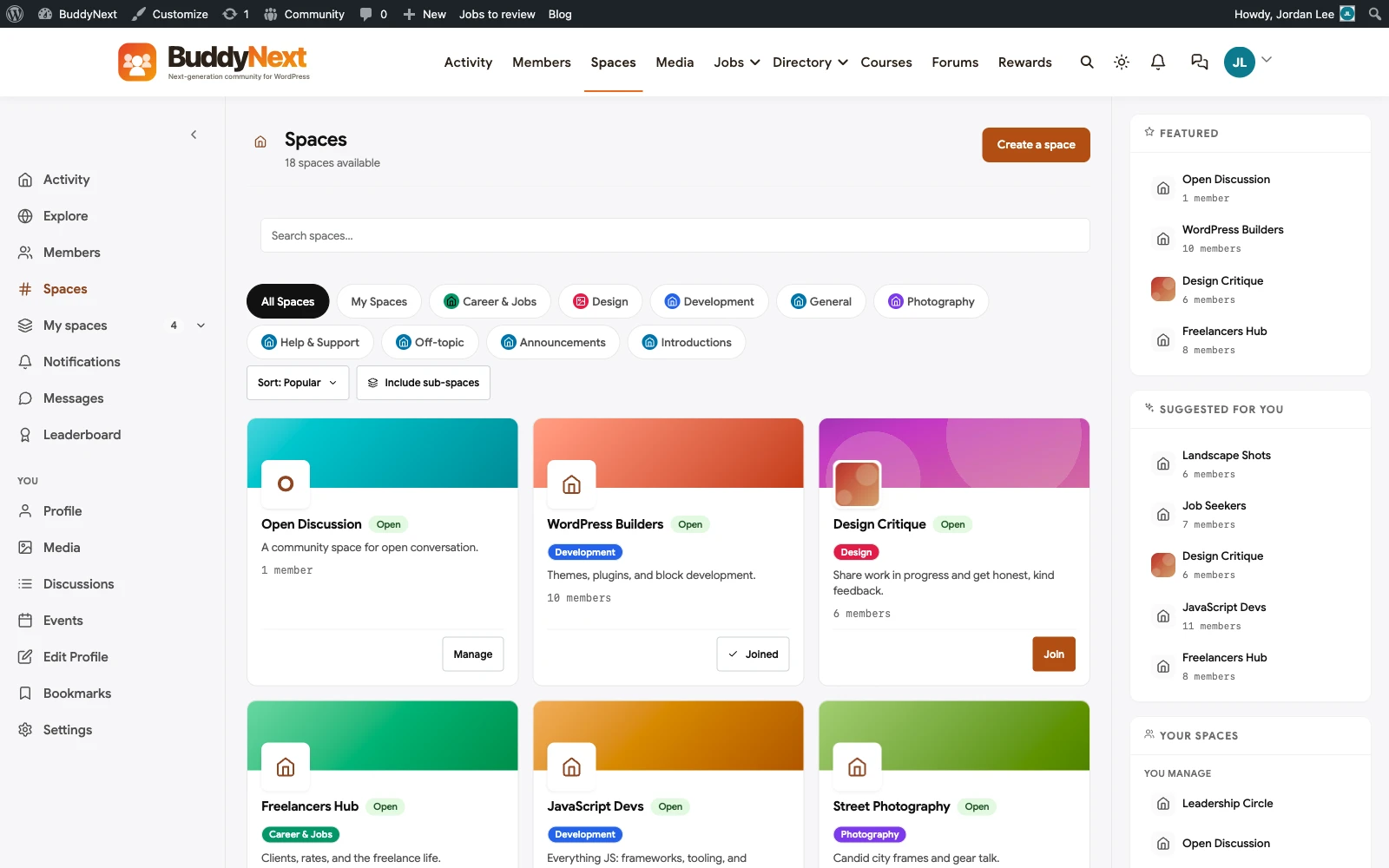
Put a realistic number on the ongoing cost: a community in the low hundreds of paying members runs comfortably on a mid-tier managed WordPress host with headroom for n8n-release-driven traffic spikes, a maintenance retainer covering plugin updates and the credential-scanning tooling, and a few hours a month of someone willing to actually work the version-flag review queue described above. None of these numbers are large in absolute terms, but they’re real, recurring, and worth planning for explicitly rather than discovering reactively once the library has grown past the point where skipping maintenance is still survivable.
Moderation specific to a workflow-sharing community
Beyond the credential-leak scanning covered above, a workflow-focused community benefits from a moderator being able to quickly tell whether a shared workflow is genuinely original work or a lightly-modified repost of something already in the library, since duplicate, low-effort content is a real quality drain on a paid library members are trusting to be curated. A simple duplicate-detection pass (comparing node structure, not just file names) run on new submissions, flagging likely duplicates for a moderator to confirm rather than auto-rejecting, keeps the library’s actual differentiator, curation quality, intact as it grows past the size where one person can eyeball every submission.
Worth deciding deliberately up front: who actually verifies a workflow’s “last verified on n8n X.Y” claim before it’s trusted. The honest answer for most small teams is “whoever submits it, on the honor system, with community flagging as the real-world check,” rather than promising an editorial verification process you don’t actually have staff to run. Overpromising a verification standard you can’t sustain is worse than being upfront about an honor-system approach backed by community flagging.
FAQ
Is it worth competing with n8n’s own official community at all?
Not head-on. The honest angle is a specific thing the official channels don’t serve well: a paid, curated, version-aware workflow library, a specific industry focus, or structured courses with accountability, not a second general-support forum. If your plan doesn’t name that specific gap clearly, it’s worth re-examining before building anything.
How do we keep the workflow library from going stale as n8n updates?
The community-flagging mechanism described above (members flag broken imports, which triggers a review) is the realistic maintenance path; no platform feature does this automatically. Budget real moderator or team time to actually act on those flags promptly, since an unreviewed flag queue is as bad as no version-tracking at all, and members notice a stale queue just as quickly as they notice a stale workflow.
Should we require members to paste workflow JSON directly, or allow file uploads?
Both, with the JSON rendered as a readable code block either way (never just a downloadable attachment with no preview), since members deciding whether to try a workflow need to read it before importing it. File upload is a convenience for longer workflows; the code-block rendering requirement applies regardless of how the content gets in.
Does this build make sense for a community under 100 members?
Generally no. Validate the paid demand on Skool or with a simple paid Discord tier first. The version-aware workflow library and custom moderation tooling described here are worth building once you have a growing, engaged paid base that justifies the engineering investment, not before you know the audience exists.
What’s the realistic cost difference between Skool and a self-hosted build at a few hundred members?
Skool’s fee structure is straightforward to estimate from its own published pricing per seat; self-hosting trades that recurring per-seat cost for hosting and maintenance costs that don’t scale with member count the same way, plus the upfront engineering investment described throughout this piece. At a few hundred paying members, the self-hosted total often comes out ahead over a year or two, but the upfront build cost needs to be weighed against how soon that breakeven actually arrives for your specific numbers.
Can we start on Skool and migrate to BuddyNext later without losing our workflow library?
Yes, and it’s a reasonable sequencing: validate the paid demand on Skool first, then migrate once the audience and the workflow library itself have real value worth owning outright. The practical catch is that Skool’s own export doesn’t preserve a workflow library’s structure or tagging, so plan the migration as a deliberate re-curation pass (reviewing and re-tagging each workflow on the new platform) rather than assuming an automatic transfer, the same caveat that applies to any Skool-to-self-hosted move covered earlier in this series.
Do we need n8n’s permission or involvement to run a community like this?
No, running a third-party community around n8n doesn’t require n8n’s permission, the same way countless unofficial communities exist around any popular tool. Be careful with branding, though: don’t imply official endorsement or partnership in your community’s name or marketing unless you actually have one, since that’s a trust issue with both n8n and your own members if it’s ever challenged.
What’s a reasonable timeline for this build, start to launch?
For the core build (BuddyNext and Jetonomy configured, the version-flag field and credential scanning in place), two to four weeks is realistic for a focused team. Add time if you’re also building the migration path from an existing Discord or Skool group, since the curation and re-tagging work there is the slower, more manual part of the whole project, not the platform configuration itself.
Related reading: for the broader AI automation community platform comparison, see our AI automation community guide and its paid-tier companion piece. For a related developer audience, see our AI agent developer community breakdown. For the underlying plugin choice on WordPress generally, our WordPress community plugins comparison covers it in depth, and if Circle is on your shortlist, our Circle alternatives piece digs into its paid-tier mechanics.
Plugins we build and run
We maintain these ourselves, which is why we can support them on your site.
- BuddyNextThe self-hosted community engine for WordPress
- BuddyXFree community theme, Pro when you outgrow it
- ReignPremium community theme. Add pieces, build anything
- JetonomyCommunity forum and Q&A for WordPress
- EventonomyEvents and RSVPs for WordPress communities
- LearnomyCourses and learning communities on WordPress
- ListoraDirectories and listings your members can browse
- SnipShareCode sharing built for developer communities
- WB Ad ManagerAd placements that turn traffic into revenue
- WP Career BoardA job board your community actually uses
- WP Sell ServicesSell services with offers, orders, and payouts
- MediaVersePhotos, video, and media albums for members
- WB GamificationPoints, badges, and rewards that keep members active
- Product RoadmapPublic roadmaps with voting your users trust