Best Platforms to Build a Web Development Learning Community
BuddyNext, Learnomy, and Jetonomy together cover how web development learners actually learn: structured courses plus real debugging Q&A in one platform.
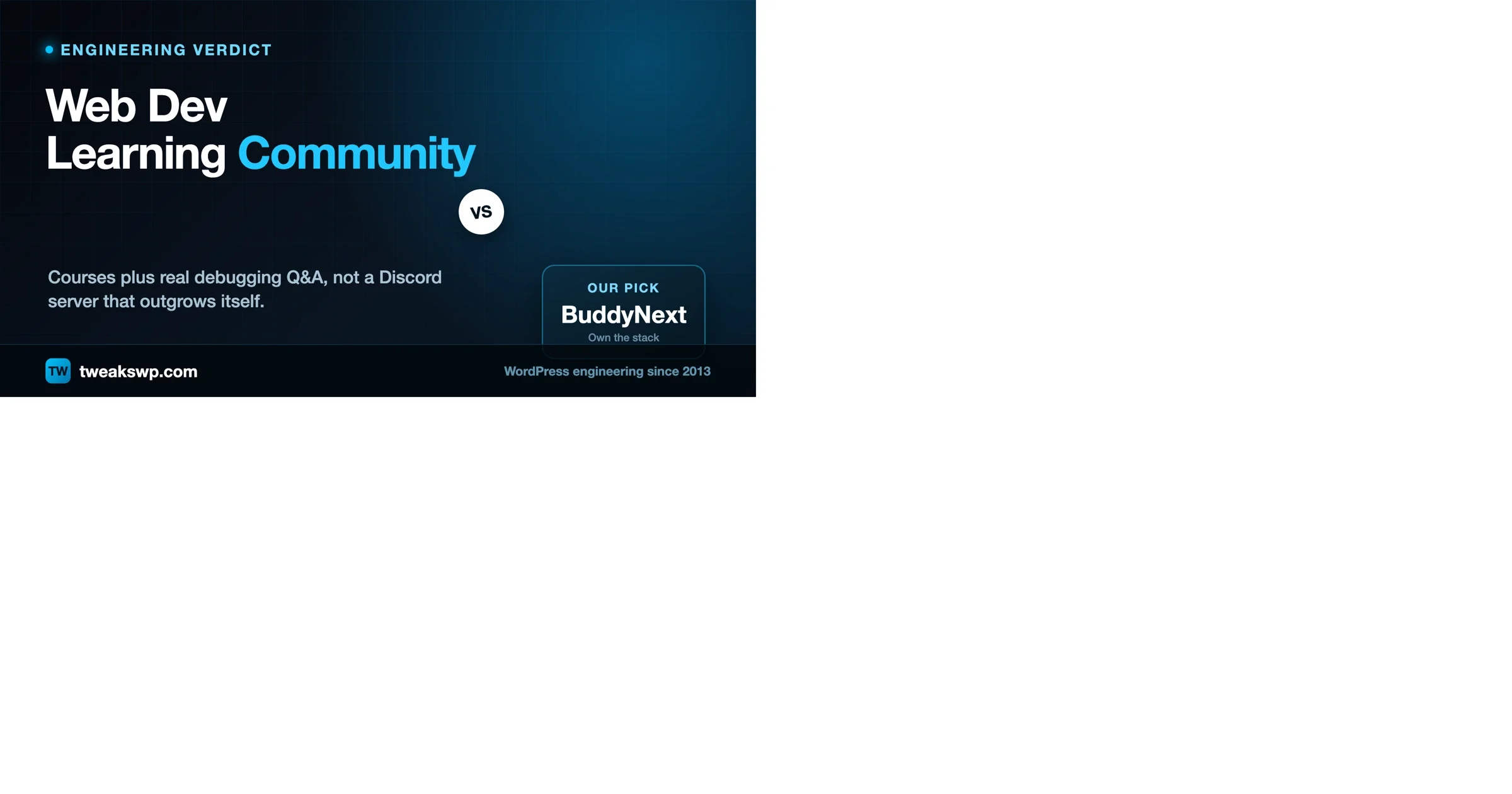
Short version: for a web development learning community, BuddyNext paired with Learnomy for structured courses and Jetonomy for Q&A is the self-hosted combination that actually covers how this audience learns, which is a mix of guided curriculum and raw troubleshooting help. freeCodeCamp’s forum and The Odin Project’s Discord dominate the free, open end of this space, but neither is something you can brand, monetize, or build a paid cohort offering on top of.
Web development learners have a specific pattern that a general community platform handles badly: they arrive at wildly different skill levels, ask questions that are often genuinely hard to answer without seeing the actual broken code, and churn fast if they don’t get a response within a day or two of getting stuck. A platform built for this audience needs to make “get unstuck quickly” the easiest possible action, not a buried feature.
What platforms actually compete here, and where they fall short
- freeCodeCamp’s forum: huge, free, excellent for beginner troubleshooting, but a shared public space you don’t own or brand, and not built for a paid course offering.
- The Odin Project’s Discord: strong peer-support culture for a specific curriculum, real-time chat is good for quick unblocking, weak for durable, searchable answers that outlive the conversation.
- Discord servers run by bootcamps: common, familiar to this audience, but history and search degrade fast once a server passes a few thousand messages, and the bootcamp’s brand gets diluted inside Discord’s own interface.
- Circle or Mighty Networks: closer to a real owned platform with course support, but recurring per-seat SaaS cost that compounds as the community grows, and less code-specific tooling than a purpose-fit setup.
- BuddyNext (self-hosted): own the platform and the brand, native Q&A via Jetonomy with code-block rendering, Learnomy for structured lessons with graded exercises, one login across community and course. Trade-off: you own hosting and the setup work.
Why code rendering and a real Q&A structure matter more here than almost anywhere else
Nearly every valuable interaction in this community involves a learner pasting broken code and someone else spotting the bug, which means syntax-highlighted code blocks with correct indentation are not a nice-to-have, they’re the core mechanic. Test this before launch with a real multi-line snippet (nested HTML, a JS function with several levels of indentation) and confirm it survives being pasted and rendered. A Q&A format with an accepted-answer marker, rather than a flat chronological feed, matters just as much: it means the fix that actually worked is visible to the next learner who hits the identical bug, instead of being buried under twelve replies of “have you tried restarting your editor.”
Building it: BuddyNext, Learnomy, and Jetonomy together
Learnomy handles the structured side: a curriculum broken into modules, graded or self-checked exercises, and a clear sense of progress, which matters enormously for a learning audience that often doubts whether they’re actually improving. Jetonomy’s Q&A layer handles the unstructured side: the “I’m stuck on this specific thing right now” questions that don’t fit neatly into a course module. BuddyNext ties the two together with one login, one profile, and one place members check daily instead of splitting attention across a course platform and a separate chat tool.
Member profiles should support a GitHub link and a portfolio URL, since demonstrating actual shipped projects matters more to this audience’s credibility and eventual job prospects than any bio text. If the community includes paid cohorts or mentorship, BuddyNext’s native Stripe membership tiers handle that directly without a separate plugin, and Learnomy’s assignment and grading flow supports a mentor reviewing submitted project code, not just multiple-choice quizzes.
Space structure for a learning community spanning total beginners to job-seekers
Separate spaces matter more here than in most niches because the gap between a week-one learner and someone three months from a job interview is enormous. A reasonable structure: a beginners’ space for fundamentals (HTML, CSS, basic JS) kept distinct from an intermediate space for frameworks and tooling, a dedicated “Code Review” space using the Q&A format specifically for pasted-code troubleshooting, a “Project Showcase” space for finished work, and a “Job Search & Career” space for resume feedback and interview prep, which is often the single most active space once a cohort reaches the later stages of a curriculum. Mixing total beginners into the same feed as job-seekers discourages both groups: beginners feel behind, and job-seekers feel like they’re wading through unrelated noise to find peers at their stage.
Migrating from a bootcamp Discord or an existing forum
Discord’s weak history export means treating a migration as a fresh start with a curated set of the best past threads manually recreated rather than attempting a full import. Run the old and new platforms in parallel for two to three weeks, announce clearly through whatever channel the cohort already trusts (the bootcamp’s own newsletter or the instructor directly, not just a pinned Discord message easy to miss), and seed the new platform with enough real content, pinned troubleshooting guides for the curriculum’s most common sticking points, a few migrated highlight threads, so it doesn’t look empty to the first wave of arrivals.
What this actually costs to run, year over year
Hosting for BuddyNext plus Learnomy and Jetonomy runs comfortably on a mid-tier managed WordPress host, roughly $25-60/month depending on member count and course-content volume (video-heavy courses need more storage and bandwidth than text-based ones). The bigger cost is mentor or TA time for code review and Q&A moderation, which for an active cohort-based program is the real operating expense, often several hours a day during an active cohort, dropping to a few hours a week between cohorts if the community stays open to alumni.
A realistic space structure, worked through
For a cohort of roughly 200 active learners: General & Introductions, Code Review (Q&A format, the highest-traffic space by far), Project Showcase, Job Search & Career, and a Resources space pinning the curriculum’s reference material so it doesn’t get buried in active discussion. Five spaces is enough to separate the distinct needs (unblocking, showing work, career prep, reference material) without fragmenting a 200-person cohort into rooms too quiet to feel alive.
Quick comparison: platforms for a web development learning community
- BuddyNext + Learnomy + Jetonomy: own the platform, structured courses plus Q&A, one login, Stripe tiers for paid cohorts. Trade-off: you own hosting and setup.
- freeCodeCamp forum: free, huge, excellent beginner support, not brandable or monetizable.
- The Odin Project Discord: strong peer culture for a specific curriculum, weak searchable history.
- Bootcamp-run Discord: familiar to learners, degrades at scale, brand diluted inside Discord’s UI.
- Circle / Mighty Networks: real owned platform with courses, recurring per-seat cost, less code-specific tooling.
Worth reading next: for the data-heavy end of this audience, see our piece on building a data science and machine learning community, and for the applied-AI crossover, an AI learning and training community.
Moderation policy specific to a learning community
The dominant moderation problem in a web development learning community isn’t abuse, it’s the slow erosion of mentor goodwill when the same unoptimized question (an unformatted error message, no code pasted, “it doesn’t work” with no further detail) gets posted dozens of times a week. Write a short, enforced posting template for the Code Review space: what you were trying to do, the actual code (pasted as a code block, not a screenshot), the exact error message, and what you already tried. This isn’t gatekeeping, it’s the single highest-leverage thing that keeps mentors answering instead of burning out, because a well-formed question takes thirty seconds to diagnose while a vague one can take ten minutes of back-and-forth just to understand what’s being asked.
Screenshots of code deserve a specific rule against them, since they can’t be copy-pasted into a fix, can’t be searched later, and often crop out exactly the line that matters. A pinned post explaining why code blocks are required, with a one-line example of how to format one, pays for itself the first week by cutting down on the “can you post that as text instead” exchange that otherwise happens constantly.
Integrating the tools this audience already uses daily
Learners in this space live inside GitHub, CodeSandbox or similar in-browser editors, and whatever deployment platform the curriculum teaches (Netlify, Vercel, or a basic VPS for more advanced modules). A member profile that links out to a GitHub username turns the community into a lightweight portfolio directory, useful both for peer code review and for the job-search space later in the curriculum. For project showcases, allowing an embedded live link (a deployed Netlify or Vercel URL) alongside the code repository link means reviewers can actually click through and use what was built, not just read about it, which produces far more useful feedback than a static screenshot ever does.
A lightweight GitHub webhook that posts into a “New Projects” space whenever a learner pushes a tagged commit or opens a pull request on a shared practice repository gives mentors a lower-friction way to notice and comment on work in progress, rather than waiting for learners to proactively post a finished project. This kind of integration is realistic to build on BuddyNext’s REST API without needing a dedicated developer on staff; a simple serverless function forwarding GitHub’s webhook payload into a community post covers most of the value.
You may not need the full build for a very small cohort
If the program is a handful of learners meeting through one instructor directly, a shared GitHub organization plus a simple Discord server for real-time unblocking genuinely covers the need without the overhead of standing up BuddyNext, Learnomy, and Jetonomy together. The investment in a full owned platform starts paying for itself once there’s a recurring cohort structure (multiple intake groups over time), a genuine alumni community worth retaining, or a paid tier where the platform itself becomes part of what’s being sold, not just a delivery mechanism for lessons that could live anywhere.
What this actually costs to run per cohort
Three line items again: hosting (roughly $25-60/month for BuddyNext plus Learnomy and Jetonomy, scaling with video storage if the curriculum is video-heavy), mentor or TA time (the dominant cost for an active cohort, easily several hours a day during a live intake), and the seed-content cost of pre-populating the Code Review space with answers to the curriculum’s most common sticking points before the first cohort arrives, so early learners aren’t the ones discovering every gap in real time. A bootcamp or instructor running this as a paid program should budget mentor time as a real line item against the tuition price, not an afterthought absorbed by whoever has spare hours that week, since under-resourcing it is the single most common reason a promising cohort-based community stalls out after the first intake.
FAQ
Do we need separate platforms for the course content and the community discussion?
Not if the platform supports both natively. Splitting course delivery (a platform like Teachable or Thinkific) from community discussion (a separate Discord or forum) is the default many bootcamps fall into, but it means two logins, two places to check, and no way for a mentor to see a learner’s course progress while answering their Q&A question. BuddyNext with Learnomy keeps both in one place, which matters more for retention than most people expect going in.
How do we keep more advanced learners from feeling like the community has nothing left to offer them?
Give advanced learners a clear next role: mentor or code reviewer in the Code Review space, with light recognition (a visible “mentor” badge or highlighted profile) for the ones who stick around to help. Communities that only serve the newest cohort lose their most capable members the moment they finish the curriculum; communities that give advanced members a reason to stay (status, teaching practice, eventually a referral into job opportunities) retain them as the backbone of future cohorts.
What’s the realistic timeline to launch this for a new cohort-based program?
Three to four weeks: a week for the BuddyNext and Learnomy build plus code-rendering verification, a week to build out the curriculum structure in Learnomy and seed the Q&A space with answers to the most common sticking points from past cohorts, a week for a small beta group to try the full flow (sign up, work through a module, ask a question, get an answer), and buffer for whatever the beta turns up before the first real cohort arrives.
Should the community stay open to alumni after they finish the curriculum, or close access?
Keeping it open, usually at a lower-cost or free alumni tier, is almost always the better call: alumni are the most reliable source of mentors and code reviewers for the next cohort, and a community that disappears the moment someone finishes paying loses the long-term relationship that turns graduates into advocates. The access-control decision is less about security here and more about which tier and space each alumni member can still see.
How much does a real mentor-review flow cost to run well?
Budget mentor time, not just platform cost, as the real expense. A paid mentor reviewing project submissions thoroughly can realistically handle ten to fifteen reviews a week; for a 200-person cohort with regular project submissions, that means several part-time mentors or a rotating volunteer-alumni system, not one person trying to cover everyone. Underestimating this is the most common reason cohort-based communities feel responsive at launch and sluggish three months in.
Is a Q&A format actually better than a flat discussion feed for debugging help?
Yes, specifically for this audience, because debugging questions have a correct answer (the thing that actually fixed the bug), and a flat chronological feed buries that answer under subsequent chatter within hours. The accepted-answer marker makes the fix permanently findable by anyone who searches the same error message later, which over a year of community activity becomes a genuinely valuable searchable archive, something a Discord server’s chat history essentially never becomes.
What’s a realistic way to measure whether the community is actually helping learners finish the curriculum?
Track completion rate by cohort against the Code Review space’s activity level for that same cohort, since the two correlate directly: learners who get unblocked quickly finish modules, learners who sit stuck for days without a good answer are the ones who quietly drop out. A simple weekly check (how many questions in Code Review went more than 24 hours without a reply) is a better early-warning signal for at-risk learners than waiting for a module deadline to pass and noticing someone didn’t submit.
Should instructors answer every question themselves, or train alumni mentors to take the load?
Train mentors as early as possible, ideally starting with the first cohort’s strongest finishers. An instructor who personally answers every Code Review question becomes the bottleneck the moment a second cohort starts, and the community’s responsiveness caps out at whatever one person’s available hours allow. A mentor program also gives recent graduates a reason to stay engaged (teaching reinforces their own learning and looks good on a resume), which solves the alumni-retention problem and the scaling problem with the same structure.
Does the community need video content built in, or is text-based Q&A enough?
Text-based Q&A with code blocks covers the large majority of debugging help this audience needs, and it’s searchable in a way video never is, which matters for a repository of past answers. Video earns its place for conceptual walkthroughs (explaining why a pattern works, not just fixing a specific bug) inside Learnomy’s structured course modules, where a learner is following a guided path rather than searching for a fix to something broken right now. Keep the Q&A side text-first and save video for the curriculum itself.
What’s the single most common mistake when launching a web development learning community?
Launching with an empty or near-empty Code Review space and expecting the first cohort to generate enough activity to make the platform feel alive on its own. The fix is straightforward but often skipped under time pressure: before the first learner arrives, seed the space with real answers to the ten or fifteen questions that come up in literally every past cohort (environment setup issues, the same handful of beginner JS gotchas, common deployment errors), so the first person who gets stuck finds a working answer immediately rather than becoming the community’s first awkward, unanswered post.
How should pricing for a paid cohort factor in the ongoing community access, not just the course content?
Treat community access and mentor availability as a distinct, named part of what’s being sold, not an implicit bonus bundled into “the course.” A learner choosing between a cheaper pre-recorded course and a more expensive cohort program is often paying specifically for the Code Review space’s response time and the alumni network, and pricing that doesn’t communicate that value explicitly undersells the actual differentiator between a self-hosted cohort community and a one-way video course platform.
What’s the real cost difference between a cohort-based course community and a self-paced one?
Cohort-based programs charge a premium (often 3-5x a self-paced course) because live instructor time is the scarce resource, and that model only works at a price point that justifies the instructor’s hours against a capped cohort size. A self-paced community built on BuddyNext plus Learnomy removes the cohort cap entirely, trading the live-cohort premium for a lower price point sustained by volume instead of scarcity, which fits a web development audience used to comparing against free resources like freeCodeCamp.
Do code review and pull-request workflows belong inside the community, or stay on GitHub?
Keep actual code review on GitHub, where diffing, inline comments, and CI checks already work properly, and use the community for the discussion a PR thread can’t hold: why a pattern is the right one, what a beginner got stuck on, which approach a mentor would take differently. Trying to replicate GitHub’s review tooling inside a community platform is wasted engineering effort against a tool built specifically for that job.
Plugins we build and run
We maintain these ourselves, which is why we can support them on your site.
- BuddyNextThe self-hosted community engine for WordPress
- BuddyXFree community theme, Pro when you outgrow it
- ReignPremium community theme. Add pieces, build anything
- JetonomyCommunity forum and Q&A for WordPress
- EventonomyEvents and RSVPs for WordPress communities
- LearnomyCourses and learning communities on WordPress
- ListoraDirectories and listings your members can browse
- SnipShareCode sharing built for developer communities
- WB Ad ManagerAd placements that turn traffic into revenue
- WP Career BoardA job board your community actually uses
- WP Sell ServicesSell services with offers, orders, and payouts
- MediaVersePhotos, video, and media albums for members
- WB GamificationPoints, badges, and rewards that keep members active
- Product RoadmapPublic roadmaps with voting your users trust