Best NodeBB Alternatives in 2026 (For Teams Already Running WordPress)
NodeBB's real-time, WebSocket-native forum is genuinely well engineered, but it means running Node.js alongside your WordPress stack. What that actually costs, and the alternative that keeps the same real-time feel inside WordPress itself.
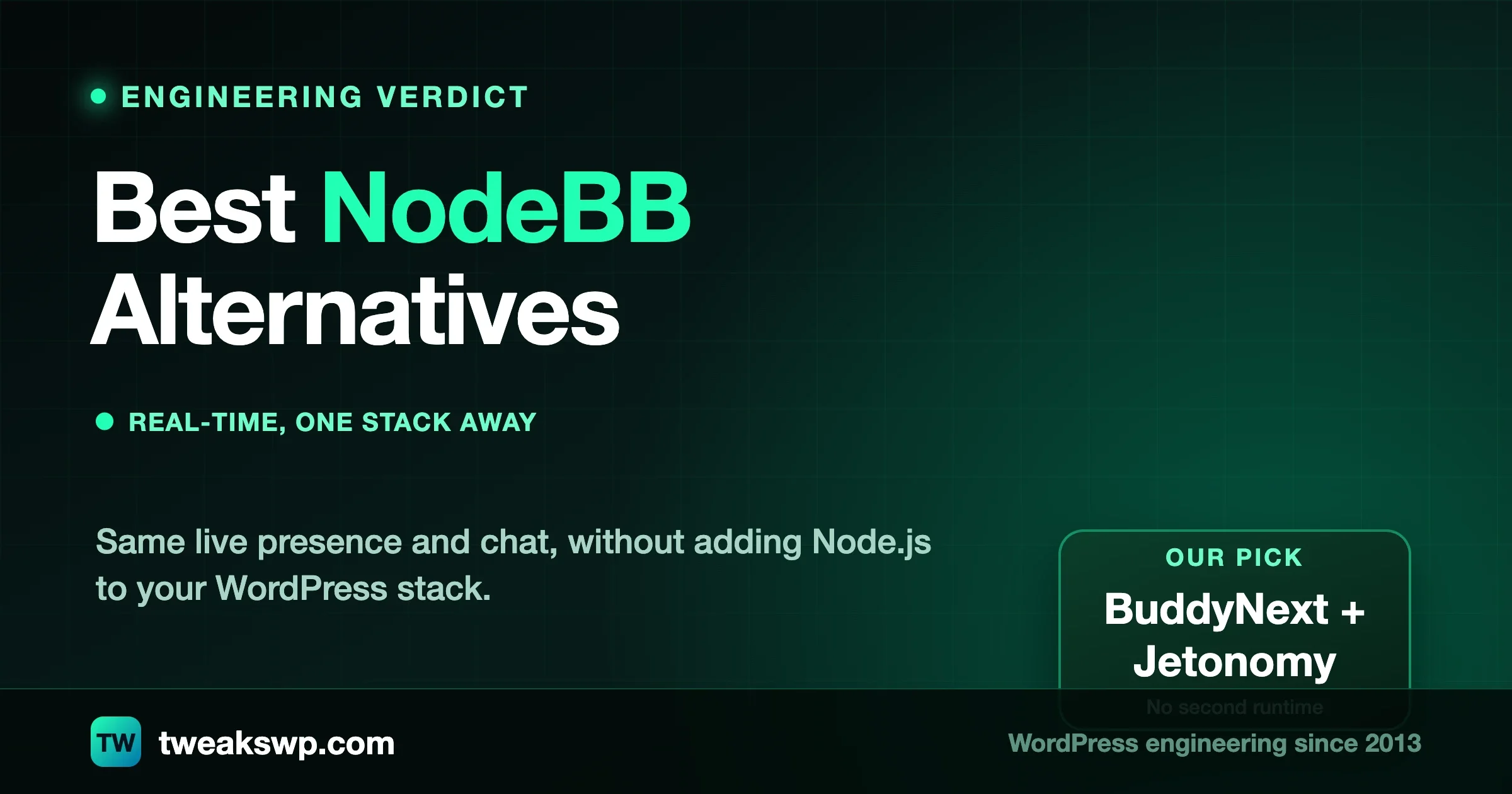
NodeBB is the open-source forum platform we hear about most from teams who specifically want their discussions to feel instant: new posts and replies arrive over WebSockets without a page reload, there’s a “who’s browsing this topic” indicator, and real-time chat sits alongside the forum itself. It’s genuinely well engineered, actively maintained software. The friction isn’t the engineering. It’s that NodeBB runs on Node.js, a different runtime than the PHP stack almost every WordPress site already runs on, which means it’s not just a second system next to your main site, it’s a second technology stack your team has to know how to operate.
This article covers what NodeBB actually does well, where that separate stack causes real friction for a WordPress-based business, and the realistic alternatives, including a WordPress-native option that gets you most of the same real-time, modern feel without adding Node.js to your infrastructure.
What NodeBB actually is
NodeBB is open-source forum software (GPLv3 licensed, free to self-host) built specifically around real-time behavior: posts, replies, presence indicators, chat, and notifications all update live without a page refresh, because the whole platform is built on WebSockets rather than the request-response pattern most forum software still uses. On top of the real-time core, it ships threaded and flat topic views, social-style notifications, reputation and karma scoring, mobile-first responsive design, a built-in analytics dashboard, and a REST API for custom integrations with other services. There’s an active plugin ecosystem, somewhere in the 300 to 400 range of maintained plugins, managed through npm the same way any Node.js project manages dependencies, covering everything from spam prevention and moderation automation to analytics widgets and alternative authentication providers. That’s a meaningfully smaller library than Flarum’s 1,200-plus or phpBB’s two-decade archive, worth knowing upfront if your community depends on a very specific niche integration that a larger ecosystem would be more likely to already cover.
NodeBB also sells managed hosting directly if you don’t want to run the Node.js service yourself: hosted plans start around $20 a month for a Starter tier and scale up to roughly $750 a month for the highest “City” tier, with every hosted tier including unlimited staff accounts, automated backups, SSL, custom plugins, and a custom domain, backed by a 14-day free trial. That hosted option exists precisely because self-hosting a Node.js service is a meaningfully different operational commitment than self-hosting a PHP application on shared or managed WordPress hosting, and NodeBB’s own team clearly knows it, which is exactly why they built and continue to maintain a managed-hosting business around their own open-source product.
It’s worth being direct about who NodeBB genuinely suits: teams that specifically value real-time interactivity as a top priority, that already have Node.js operational experience or are willing to either pay for hosted or build that experience, and that are fine running a forum as a standalone product rather than an extension of an existing site. If that’s genuinely your situation, NodeBB is a strong, honestly engineered choice worth taking seriously. The rest of this article addresses the more common case we see: a business already running WordPress for its main site, trying to decide whether NodeBB’s real-time edge is worth taking on an entirely separate technology stack to get.
Where the friction actually is
A different runtime means a different team of people who can maintain it
Most WordPress hosting is built around PHP and MySQL or MariaDB. NodeBB needs Node.js and Redis or MongoDB, a genuinely different set of moving parts with their own update cycles, their own security patching cadence, and their own operational quirks. If your team’s technical staff or hosting provider is set up around a PHP-and-WordPress world, which describes most of the clients we work with, self-hosting NodeBB means either building new operational capability from scratch or handing the job to NodeBB’s own managed hosting and paying for it monthly, indefinitely.
The hosted-versus-self-hosted cost math is real and easy to get wrong
Choosing self-hosted to avoid the monthly hosted fee only actually saves money if you genuinely account for the staff time to run a Node.js service correctly: monitoring, patching, scaling the WebSocket connections as your community grows, configuring Redis or MongoDB correctly from day one, and recovering cleanly from the kind of outage a stateful real-time service experiences differently than a stateless PHP page. Teams that budget the hosted plan’s price tag in their head but then choose self-hosting to save it often end up paying the equivalent in staff hours they didn’t account for, or migrating to the hosted tier a year later once the maintenance burden becomes visible.
Still a separate member database and a separate login
Exactly the same structural issue as every other standalone forum platform in this series: NodeBB’s member accounts, karma, and activity history live in their own database, disconnected from WordPress unless you build and maintain an SSO bridge yourself. A member ends up managing two separate accounts, or you take on an integration project to merge them, and the forum reads as a separate destination with its own identity rather than a natural extension of your main site.
Scaling WebSockets is a different operational problem than scaling PHP pages
A traditional PHP page request is stateless: a server handles it, returns a response, and moves on, which is exactly why PHP hosting has scaled relatively simply for two decades. A WebSocket-based service like NodeBB keeps a persistent, stateful connection open for every active user, which means horizontal scaling (adding more servers as your community grows) requires sticky sessions or a shared pub-sub layer like Redis to keep real-time events synchronized across instances. That’s a genuinely different, more involved scaling problem than the one most WordPress hosting providers are built to solve, and it’s part of why NodeBB’s own hosted tiers price up steeply as community size grows, from roughly $20 a month at the entry tier to around $750 a month at the top tier. The jump reflects real infrastructure cost, not an arbitrary pricing ladder, and it’s worth understanding before you assume the entry-level hosted price is what you’ll actually pay once your community gains real traction.
The alternatives, in order of what we’d actually recommend
1. BuddyNext: real-time presence and activity, running on the same WordPress install
BuddyNext covers the social and discussion layer NodeBB provides, and does it on the exact same PHP-and-WordPress stack the rest of your site already runs on, with no second runtime to operate. It ships WebSocket-based real-time presence as a core platform feature, members can see who’s active, notifications arrive live, activity feed updates appear without a refresh, the same real-time feel NodeBB built its whole identity around, but as one capability inside a complete community platform rather than the platform’s entire reason for existing.
For the specific forum and discussion use case NodeBB is usually chosen for, Jetonomy is the honest companion piece: classic threaded forums and Q&A with accepted answers, on purpose-built database tables rather than WordPress’s own post tables stretched to do a job they weren’t designed for, which is exactly the kind of architectural decision that keeps a platform fast as a community grows, the same engineering priority that drives NodeBB’s own design. Jetonomy’s reputation system (points for posting, replying, and having answers accepted, feeding a trust-level ladder that grants more capability as members prove themselves) covers the same ground as NodeBB’s karma scoring, with the added benefit of running on your existing login rather than a second account system.
The honest trade-off against NodeBB specifically: if raw real-time responsiveness at very large scale, thousands of concurrent WebSocket connections, is your actual top priority, NodeBB’s purpose-built architecture for exactly that problem is hard to match from inside a general-purpose CMS platform. For the overwhelming majority of community sizes our clients actually run, the difference isn’t perceptible to members, and the one-login, one-stack, one-maintenance-burden advantage of staying inside WordPress outweighs a real-time edge most communities never grow large enough to need.
The structural piece worth naming directly: BuddyNext’s Spaces (its term for groups or sub-communities) support open, private, and secret visibility with their own moderation and join policies, the same organizational flexibility NodeBB’s categories and groups provide, but inheriting WordPress’s own role and capability system rather than requiring a parallel permissions model. A Space owner can moderate their own area without needing full site-admin access, which matters the moment more than one person is running different parts of a growing community.
2. Discourse: more mature plugin ecosystem, same hosted-or-self-hosted decision
Discourse and NodeBB get compared constantly because they solve a similar problem with a similar hosted-or-self-host choice. Discourse’s trust-level and plugin ecosystem is more mature, having had longer in the market, while NodeBB’s real-time architecture is generally considered the more technically modern approach to live updates. If you’ve ruled out WordPress-native entirely and are choosing between standalone forum platforms, this is the real head-to-head comparison worth running, covered in more depth in our separate Discourse alternatives article.
3. Flarum: lighter, PHP-based, same language as your WordPress hosting
Flarum is worth a direct look specifically because it shares a language with your existing WordPress infrastructure. It’s PHP-based, free and open-source, and deliberately minimal by default, extending through a large third-party extension ecosystem rather than shipping everything built in. It doesn’t match NodeBB’s WebSocket-native real-time feel, but if the Node.js runtime itself is the specific blocker for your team, Flarum removes that blocker while staying a standalone system with its own login and database. Our separate Flarum alternatives article covers that platform’s own trade-offs in more depth if it’s a closer fit to what you’re evaluating.
4. phpBB: the most mature, PHP-native, least modern-feeling by default
phpBB has been actively maintained since 2000, with the deepest extension and style library of any open-source forum platform and, like Flarum, a PHP foundation that at least matches your hosting’s existing language. Its default interface and real-time capabilities (there aren’t any, meaningfully) are the most dated in this comparison set, but for teams specifically prioritizing PHP-native, battle-tested stability over any real-time features, it remains a legitimate option. Two decades of community-contributed extensions means an edge case you can’t solve elsewhere is more likely to have a ready-made answer here than on a newer platform.
5. XenForo: commercial, polished, not trying to be real-time-first
XenForo is paid software, licensed rather than free, and it’s built around a traditional, highly polished forum experience rather than NodeBB’s real-time-first approach. Large, mature standalone enthusiast communities that want admin polish and strong anti-spam tooling over live-updating interactivity should weigh it on its own terms, accepting a license cost in exchange for a level of out-of-box refinement the free options in this list don’t quite match.
- NodeBB: self-hosted (Node.js) or hosted from around $20/month. Best fit: real-time interactivity as the top technical priority, with the operational capacity or budget to match. Loses on requiring a separate runtime from a PHP-based WordPress stack.
- BuddyNext + Jetonomy: WordPress plugins. Best fit: the same real-time presence and discussion experience, on the exact stack your site already runs. Loses on raw real-time throughput at very large scale compared to NodeBB’s purpose-built architecture.
- Discourse: self-hosted free or hosted paid. Best fit: a more mature plugin ecosystem, similar hosted-or-self-host decision as NodeBB. Loses on the same separate-system problem.
- Flarum: self-hosted, open-source, PHP. Best fit: a lighter forum that at least shares a language with WordPress hosting. Loses on NodeBB’s real-time feel and on being a separate system regardless.
- phpBB: self-hosted, open-source, PHP. Best fit: the deepest extension library, PHP-native stability. Loses on a dated interface and no meaningful real-time features.
- XenForo: commercial license. Best fit: polish and anti-spam tooling over real-time interactivity, for a standalone community. Loses on cost and zero WordPress integration.
If you decide to move into WordPress, here’s what actually has to happen
Moving a live NodeBB community into WordPress is a genuine migration project, and the runtime difference makes the data-export step more involved than a same-stack move would be.
First, export your content and member data through NodeBB’s own export tooling or API, then map it carefully into the new platform’s structure, deciding deliberately how karma and reputation translate into the new trust-level system rather than resetting every member to zero, which reads as a real demotion to your most active contributors. Second, audit which NodeBB plugins your community actually depends on day to day, not just the ones you remember installing, since a plugin added for a one-time need is easy to forget is still active months later, and confirm the equivalent capability exists on the WordPress side before committing to a cutover date. Third, build the redirect map from every indexed NodeBB thread URL to its new location, protecting the search equity a mature forum accumulates over years. Fourth, run both systems in parallel for a defined window, with the old NodeBB instance staying live and read-only accessible, before you take it fully offline, so a migration issue surfaces with time to fix it rather than after your only copy is gone.
There’s a fifth step specific to a NodeBB migration worth naming: decommissioning the Node.js infrastructure itself once the cutover is confirmed stable, not just turning off the forum’s public URL. A Node.js service, its Redis or MongoDB database, and whatever server or container it runs on all need a deliberate shutdown and cleanup, including revoking any API keys or credentials tied to it, rather than being left running indefinitely as forgotten infrastructure that still costs money and still represents an attack surface nobody’s watching.
Test every plugin-dependent feature your community actually relies on day to day before committing to a cutover date, not just the obvious headline features your team would list from memory. A specific spam-prevention integration, a custom notification rule, a particular analytics widget your team checks weekly, these are easy to miss in a quick audit and painful to discover missing after members have already moved over. Walk through your community’s actual daily usage patterns deliberately, and ask your most active members directly what they’d miss; they’ll surface edge cases a technical review alone tends to overlook.
Communicate the change to your members before it happens, not after. Their accounts, content, and standing in the community are what’s carrying over; the login screen and the surrounding site are what’s changing. A short notice window with a clear explanation prevents most of the friction a surprise migration generates.
That migration planning, the data mapping, the security hardening on the receiving WordPress install, making sure it’s actually production-ready rather than a demo-day setup, is exactly the kind of engineering work our team does for clients evaluating this move, day in and day out. If you’re seriously considering it, that conversation is worth having before you touch an export button.
FAQ
Does BuddyNext’s real-time presence actually match NodeBB’s WebSocket architecture?
For the community sizes most businesses actually run, yes, members see live presence, activity updates, and notifications without a refresh. At genuinely massive scale, tens of thousands of concurrent connections, NodeBB’s purpose-built real-time architecture has an edge that a general-purpose CMS platform built on top of WordPress will eventually feel. Most communities never reach the size where that difference becomes perceptible to members.
Is NodeBB’s hosted plan actually worth it compared to self-hosting?
If your team doesn’t already have Node.js operational experience, the hosted plan is very often the cheaper real option once you account honestly for the staff time self-hosting would require: patching, monitoring, scaling, and incident recovery for a stateful service most WordPress-focused teams haven’t operated before. Self-hosting only wins the cost comparison for teams that already have that capability sitting idle.
Will we lose our community’s karma and reputation history moving to WordPress?
Only if the migration maps it carelessly. A properly planned migration translates NodeBB’s karma scores and activity history into the receiving platform’s equivalent reputation system rather than discarding them, so your most active, highest-reputation members land in a standing that reflects their actual history, not a reset.
Do we need Node.js expertise on staff even after we move off NodeBB?
No, that’s specifically the operational burden this move removes. Once your community runs on BuddyNext and Jetonomy inside WordPress, you need the same PHP and WordPress maintenance capability your main site already requires, not a second, separate skill set for a Node.js service most WordPress-focused teams don’t have in-house to begin with. That consolidation, one stack, one set of credentials to secure, one team that actually understands the whole system, is often a bigger operational win than any individual feature comparison in this article.
What about NodeBB’s chat feature specifically, is there an equivalent?
BuddyNext includes direct messaging as part of its core platform, covering the same real-time private conversation need NodeBB’s built-in chat addresses, running on the same member base and login as the rest of the community rather than as a separate real-time service.
Is our community actually large enough that NodeBB’s real-time architecture matters?
For most businesses and creators running a community alongside a product, a course, or a membership, the honest answer is no, the perceptible difference between a WebSocket-native platform and a well-built presence system inside a broader CMS shows up only at a scale most communities never reach. If you’re not sure, look at your actual concurrent active-member counts rather than your total member list; it’s almost always far smaller than people assume, and far smaller than the point where the architectural difference becomes visible to anyone using the site. A total membership in the thousands with a typical handful or two of people actively online at once behaves nothing like the scale NodeBB’s architecture was specifically built to solve for.
What happens to our NodeBB plugins that don’t have a direct WordPress equivalent?
That’s exactly what the plugin audit step in a careful migration is for: identifying those gaps before you commit to a date, not after members notice something missing. Some gaps are genuine (a very specific integration with another Node.js service you run), and the honest answer there is to either rebuild that integration against the new platform’s API or accept the trade-off deliberately, rather than discovering it as a surprise mid-migration.
Plugins we build and run
We maintain these ourselves, which is why we can support them on your site.
- BuddyNextThe self-hosted community engine for WordPress
- BuddyXFree community theme, Pro when you outgrow it
- ReignPremium community theme. Add pieces, build anything
- JetonomyCommunity forum and Q&A for WordPress
- EventonomyEvents and RSVPs for WordPress communities
- LearnomyCourses and learning communities on WordPress
- ListoraDirectories and listings your members can browse
- SnipShareCode sharing built for developer communities
- WB Ad ManagerAd placements that turn traffic into revenue
- WP Career BoardA job board your community actually uses
- WP Sell ServicesSell services with offers, orders, and payouts
- MediaVersePhotos, video, and media albums for members
- WB GamificationPoints, badges, and rewards that keep members active
- Product RoadmapPublic roadmaps with voting your users trust