Best PeepSo Alternatives in 2026 (Real-Time Chat, Bundle Pricing)
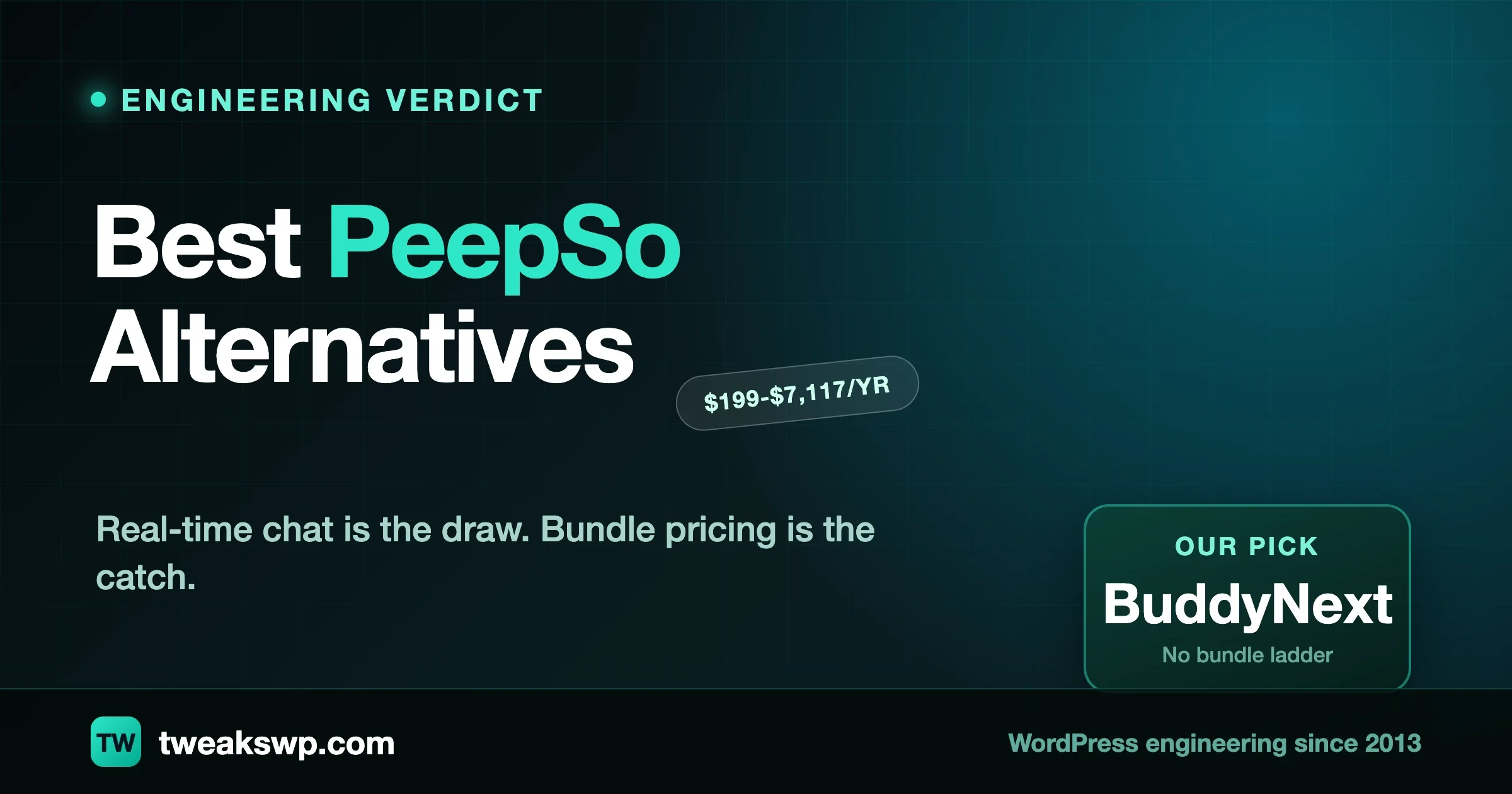
PeepSo's real-time chat is genuinely strong, but its bundle pricing ($199-$7,117/yr) adds up as you grow. What that actually costs, the real alternatives, and what a PeepSo migration audit checks.
PeepSo comes up in a specific kind of client conversation: someone wants their WordPress community to feel like Facebook, not a forum and not a course platform, with real-time chat, a social feed, and member-to-member connections that update live. PeepSo built its entire reputation on nailing that specific feel. This article looks at what it actually does well, where its pricing and architecture create friction, and what the real alternatives are, including a platform built for the same “feels like a real social network” goal with a different ownership model.
What PeepSo actually is
PeepSo is a WordPress plugin built from scratch as its own social-networking platform, not a layer on top of BuddyPress. Its core strength is real-time interaction: live chat with no extra configuration, instant status updates, and a news feed designed to feel like a mainstream social app rather than a WordPress add-on. The free version covers a genuinely usable base: a choice of two included themes, plus audio and video, friends, and groups plugins. Beyond that, PeepSo sells its features as bundles. A Starter Bundle (seven plugins, one site) runs from $199 a year, a Community Bundle with the full plugin set runs from $249 a year, and at the top end PeepSo offers a managed service called Power Suite at $7,117 a year, where PeepSo itself handles your hosting, infrastructure, mobile apps, and five hours a month of custom development.
Worth noting for anyone evaluating it now: PeepSo’s listing on the official WordPress.org plugin directory was closed at the author’s request in late 2024, so it’s distributed directly from peepso.com rather than through wp.org. That’s not inherently a problem, plenty of serious commercial plugins sell direct, but it does mean you’re trusting a single vendor’s own distribution and update channel rather than the additional layer of wp.org’s review process, which is worth knowing going in rather than discovering later.
Where the friction actually is
The bundle pricing adds up fast, and faster than it looks at first glance
The free tier is a real, usable product, which is genuinely good. But most communities that start on the free tier eventually want something in a bundle, a specific feature, a particular theme variation, or the Stories feature PeepSo added in May 2026. At that point you’re paying an annual fee on top of your hosting costs, every year, for as long as the community runs, which is the same structural pattern as a hosted SaaS subscription even though the plugin itself lives on your own server. You own the install, but you’re still renting the feature set above the free tier.
One vendor, one plugin, one point of failure for updates
Because PeepSo is a single, self-contained platform rather than an ecosystem of interoperable plugins from different vendors, you avoid the multi-plugin compatibility headaches that come with a BuddyPress stack, but you also have exactly one vendor responsible for every part of your community’s functionality. If PeepSo’s own roadmap deprioritizes a feature you need, or their release cadence slows, there’s no alternate vendor filling that specific gap the way there might be in a more modular ecosystem. That trade-off cuts both ways: fewer integration headaches, but also fewer places to turn if PeepSo itself stalls on something that matters to you.
Real-time chat is a genuine differentiator, but it’s also a hosting and scaling responsibility
Zero-config real-time chat is PeepSo’s standout feature, and it’s a real one, BuddyBoss hasn’t matched it as cleanly. But real-time features are also the part of any self-hosted platform most sensitive to your actual server and hosting choice. A shared hosting plan that handles a static-feeling activity feed just fine can struggle with the connection overhead of live chat at even moderate concurrent user counts. PeepSo being self-hosted means that scaling responsibility, and the hosting cost of handling it properly, sits with you, not a SaaS vendor’s infrastructure team, unless you’re paying for the Power Suite tier specifically to hand that over to PeepSo itself.
The theme and design layer is narrower than a full platform’s
PeepSo ships with a choice between two included themes (Block and Gecko), which cover the basics competently but aren’t a full design system in the way a dedicated community platform’s theming layer is. Matching a specific brand beyond what those two themes allow, custom color tokens, dark mode that follows a design system rather than a simple toggle, layout variations built specifically for feed, profile, and group screens, generally means custom theme development on top of what PeepSo ships, the same kind of design work you’d need on raw BuddyPress, just starting from a more polished baseline.
Who PeepSo actually fits best
Despite the friction points above, PeepSo is a genuinely strong, defensible choice for a specific kind of operator: someone who has evaluated the real-time chat experience directly (not just read about it) and decided it’s the single most important feature for their community, is comfortable with WordPress plugin management and self-hosting, and whose community size and budget make the bundle pricing a reasonable ongoing cost rather than a surprise. Fitness communities, hobby groups organized around frequent real-time coordination, and niche social apps built as a WordPress side project are all common, legitimate PeepSo use cases where its specific strengths line up with what the community actually needs day to day.
Where PeepSo is a weaker fit is for a community that needs courses, structured paid-membership tiers beyond what its plugin set covers natively, or a design system flexible enough to match an established, distinct brand without custom theme work. Those are the cases where evaluating the alternatives below is worth the time before committing to PeepSo’s specific bundle structure.
The alternatives, in order of what we’d actually recommend
1. BuddyNext: the same real-time, social-feed-first goal, one platform instead of a bundle ladder
BuddyNext targets the same thing PeepSo built its reputation on, a community that feels like a real social network rather than a bolted-together forum, with WebSocket-powered real-time presence, an activity feed with reactions and five-level threaded comments, and direct messaging with voice notes and media sharing built in. The difference from PeepSo’s model is structural rather than feature-for-feature: instead of a free core plus a ladder of paid bundles that grows as your needs grow, BuddyNext ships as one coherent platform with native Stripe membership tiers, deep moderation, thirteen-field member profiles with a searchable directory, and connected companion tools for courses, forums and Q&A, and gamification, all under one brand and one design system rather than an accumulating stack of add-on purchases.
The honest trade-off: PeepSo’s single-vendor simplicity means fewer moving parts to configure initially, and its real-time chat specifically has a longer track record than any newer platform’s equivalent. If live chat is the single feature your community most needs and you’re comfortable with PeepSo’s bundle pricing at your expected scale, PeepSo’s maturity on that specific feature is a legitimate reason to choose it. BuddyNext is the stronger pick if you want that real-time, social-first feel as part of a genuinely complete platform, courses, paid membership, forums, gamification, without paying per bundle as your community’s needs expand.
2. BuddyBoss: the other major commercial WordPress community platform
BuddyBoss is PeepSo’s most direct commercial competitor, built on the BuddyPress architecture rather than from scratch, with a stronger learning-management and mobile-app-builder story but a less polished real-time chat experience than PeepSo’s. If courses and a branded native mobile app matter more to you than best-in-class live chat, BuddyBoss is worth comparing directly against PeepSo on that basis rather than assuming they’re interchangeable.
3. BuddyPress: free, if you’re willing to assemble real-time features yourself
Plain BuddyPress doesn’t ship PeepSo’s real-time chat or Facebook-style feed experience out of the box, and matching it means layering on additional plugins and configuration. It’s worth knowing about specifically as the free-core option if budget is the primary constraint and you’re willing to do the integration work PeepSo and BuddyBoss have already done for you as commercial products.
Honorable mention: BuddyBoss and PeepSo aren’t actually interchangeable
It’s worth saying directly: the two platforms get compared constantly, but they’re not solving the same problem equally well. PeepSo wins decisively on real-time interaction. BuddyBoss wins decisively on courses, structured learning paths, and a mature native mobile app builder with years of shipped client apps behind it. Choosing based on brand recognition alone, rather than which specific capability your community actually needs more, is the single most common mistake we see in this comparison.
4. FluentCommunity: a newer, lighter alternative with a different pricing philosophy
FluentCommunity, from the team behind FluentCRM, is a newer entrant positioned around speed and a modern admin interface rather than PeepSo’s real-time-first feature set. It’s worth a direct look if what’s actually driving your PeepSo evaluation is general platform modernity rather than live chat specifically, since FluentCommunity’s ecosystem and feature maturity are both younger than PeepSo’s established track record.
5. Mighty Networks: if hosted and real-time both matter, and self-hosting isn’t a requirement
If the appeal of PeepSo is specifically the real-time, social-app feel and you’re not actually committed to self-hosting, Mighty Networks delivers a comparable live, social-first experience as a hosted SaaS product, trading the ownership and one-time-bundle-cost model for a recurring subscription and someone else’s infrastructure handling the real-time scaling question entirely.
- PeepSo: self-hosted, free core plus paid bundles from $199/yr, real-time chat is the standout. Best fit: live chat is the priority feature and you’re fine with bundle pricing. Loses on costs accumulating as you add bundles, and single-vendor dependency.
- BuddyNext: self-hosted, one platform, no bundle ladder. Best fit: want the same real-time social feel as part of a genuinely complete platform. Loses on PeepSo’s longer track record specifically on live chat.
- BuddyBoss: self-hosted, BuddyPress-based, stronger on courses and mobile apps. Best fit: courses and a branded app matter more than best-in-class chat. Loses on a less polished real-time experience than PeepSo’s.
- BuddyPress: free, self-hosted, no real-time features built in. Best fit: budget is the main constraint and you’ll build real-time yourself. Loses on needing significant extra work to match PeepSo’s out-of-box experience.
- FluentCommunity: self-hosted, newer, lighter, modern interface. Best fit: platform modernity matters more than real-time chat specifically. Loses on a smaller, younger ecosystem than PeepSo’s.
- Mighty Networks: hosted SaaS, real-time and social-first. Best fit: you want PeepSo’s live feel without self-hosting the scaling responsibility. Loses on the recurring-rent model this whole series has covered elsewhere.
If you decide to move off PeepSo, here’s what actually has to happen
A PeepSo migration has one specific wrinkle the others in this series don’t: real-time chat history and live-session data don’t have a standard export format the way posts and profiles do, because that data was never designed to be portable between platforms in the first place. Plan for that explicitly rather than assuming “we’ll export everything” covers it.
The real work has three parts. First, audit what you’re actually using from your current bundle, since PeepSo’s bundle structure means you may be paying for (and your members may be using) features that need a specific, deliberate replacement rather than an assumed one on the new platform. Second, decide what happens to chat history: whether it’s archived read-only, summarized, or accepted as a loss, communicated to members ahead of the cutover rather than discovered by them after. Third, test the new platform’s real-time features under genuinely concurrent load before launch, not just with a handful of staging accounts, since real-time connection handling is exactly the kind of thing that looks fine at low volume and breaks at the member count your community actually has.
That load-testing and chat-data-handling work is exactly the kind of migration planning we do for clients moving between real-time-dependent platforms, because the parts that look simple on a feature checklist, like “we both have chat,” are usually where a rushed migration actually breaks something members notice immediately.
One more specific consideration if you’re moving away from the Power Suite managed tier: you’re not just migrating data, you’re also taking back operational responsibility for hosting, infrastructure, and the custom development PeepSo’s team was previously handling as part of that service. Budget for that transition explicitly, whether that means hiring it out or building the in-house capability, rather than assuming the technical migration and the operational handover are the same piece of work finishing at the same time.
What we actually check before recommending a PeepSo migration
When a PeepSo community asks us to evaluate a move, the audit starts with usage, not features. Which of the paid bundle’s plugins are actually active and used by members versus installed and forgotten, how many concurrent users the live chat typically handles at peak (not theoretical capacity, actual logged numbers), and whether the community’s real complaint is about PeepSo itself or about something adjacent, hosting costs, a theme that’s never quite matched the brand, a missing course feature that was never PeepSo’s job to begin with.
That last point matters more than it sounds. A meaningful share of “should we switch platforms” conversations turn out to be “we need a course feature PeepSo was never built to provide,” which is a product-fit question, not a PeepSo-is-failing-us question. In those cases the honest recommendation is sometimes to keep PeepSo for what it does well and add a separate, purpose-built tool for the missing piece, rather than a full platform migration driven by one gap. We say that plainly when it’s true, because a migration recommended for the wrong reason costs real time and real risk for a problem a smaller, cheaper fix would have solved, and a vendor with an incentive to sell a migration doesn’t always lead with that answer first.
One more thing worth weighing before you decide
Price-per-feature comparisons are useful but incomplete for a decision like this. The actual cost of any of these platforms, PeepSo included, is the sum of the license or subscription, the hosting capable of handling your real-time load if that matters to you, the design work to make it feel like your brand rather than a template, and the ongoing time someone on your team spends keeping it current. Run that fuller total against your actual budget and team capacity before committing, rather than comparing headline bundle prices in isolation, because the headline number is rarely the number you end up paying across a full year of running a real community on top of it.
FAQ
Is PeepSo’s free version actually usable, or is it a stripped-down trial?
It’s a genuinely functional product: a theme, audio and video, friends, and groups are all included free, not gated behind a trial period. Most communities outgrow it as they want specific features like Stories or the full plugin set, at which point the paid bundles come in, but the free tier itself isn’t artificially limited to force an upgrade.
Why would anyone pay $7,117 a year for the Power Suite tier instead of just hosting PeepSo themselves?
That tier is for teams that specifically don’t want to manage hosting, infrastructure, or mobile app builds themselves, and are willing to pay a premium for PeepSo’s team to handle it plus five hours a month of custom development. For a team with its own development and hosting capability, self-managing a lower bundle tier is usually the better value; the Power Suite makes sense specifically when you don’t have that capability in-house and the alternative is hiring it separately.
Does BuddyNext have real-time chat as good as PeepSo’s?
BuddyNext ships WebSocket-powered real-time presence and direct messaging with voice notes and media sharing as part of the core platform. PeepSo’s live chat has a longer specific track record at this exact feature, built and refined over more years focused specifically on that experience. If live chat quality at scale is your single deciding factor, evaluate both directly against your actual concurrent user expectations rather than taking either vendor’s description at face value.
Can we migrate from PeepSo without losing our members’ connection and friend data?
Friend connections and member relationships are generally more portable than real-time chat history, since they’re structured relational data rather than ephemeral session data. Map that data explicitly as part of migration planning, and verify it post-migration with a real user audit, rather than assuming a general export tool captured every relationship correctly.
Does switching away from PeepSo mean we lose access to its specific themes, Block and Gecko?
Yes, those themes are built specifically for PeepSo’s structure and won’t carry over to a different platform’s data model regardless of which alternative you choose. Treat the visual design as something you’re rebuilding on the new platform, not migrating, and budget design time accordingly rather than assuming the new platform’s default look is a drop-in replacement for your current branding and layout conventions.
Is the closure of PeepSo’s wordpress.org listing a sign the plugin is being discontinued?
No, it reflects a distribution decision, PeepSo continues to sell and update through its own site, peepso.com, rather than the WordPress.org repository. It’s worth factoring into your evaluation as a distribution and trust consideration (you’re relying on the vendor’s own channel rather than wp.org’s additional review layer), not as a signal the product itself is being abandoned.
What does PeepSo’s Stories feature actually add, and do we need it?
Stories, added in May 2026 and included in the Ultimate Bundle, brings the disappearing-photo-and-video-update format popularized by Instagram and Snapchat to a PeepSo community. Whether you need it depends entirely on your members’ expectations: a younger, visually-driven community will likely use it heavily, while a professional or support-focused community may never touch it. Evaluate it against how your specific members actually communicate rather than adding it because it’s available in a bundle you’re already paying for. Check actual usage data a month or two after enabling it, rather than assuming it’s working because it’s visible in the interface, since a feature nobody uses still costs you the bundle price either way.
Should we evaluate PeepSo and BuddyNext with the same test community, or separately?
Run them in parallel with the same real test scenario, real members (or a representative volunteer group), the same concurrent-use conditions, the same content imported into both. Feature lists read similarly on paper; the actual feel of real-time chat, feed responsiveness, and moderation workflow under real use is where the two platforms genuinely diverge, and that only shows up in hands-on testing, not a comparison table. Budget at least a couple of weeks for this kind of side-by-side evaluation rather than a single afternoon demo of each, since real-time behavior under light testing and under genuine member load can look surprisingly different.
Plugins we build and run
We maintain these ourselves, which is why we can support them on your site.
- BuddyNextThe self-hosted community engine for WordPress
- BuddyXFree community theme, Pro when you outgrow it
- ReignPremium community theme. Add pieces, build anything
- JetonomyCommunity forum and Q&A for WordPress
- EventonomyEvents and RSVPs for WordPress communities
- LearnomyCourses and learning communities on WordPress
- ListoraDirectories and listings your members can browse
- SnipShareCode sharing built for developer communities
- WB Ad ManagerAd placements that turn traffic into revenue
- WP Career BoardA job board your community actually uses
- WP Sell ServicesSell services with offers, orders, and payouts
- MediaVersePhotos, video, and media albums for members
- WB GamificationPoints, badges, and rewards that keep members active
- Product RoadmapPublic roadmaps with voting your users trust